Get Full Government Meeting Transcripts, Videos, & Alerts Forever!
Get email alerts on the Education Budget topic
No spam. Unsubscribe anytime.
Education committee tells Appropriations panel it supports free community college, preschool funding and bell‑to‑bell cell‑phone policy
Summary
Education committee members presented their report back to the Appropriations Committee, urging maintenance of a 55% state share, a $50,000 minimum, permanence for the free community college program, $16 million for public preschool and funding for Maine Public; members debated CDS transfer and the scope and cost of a statewide bell‑to‑bell cell‑phone ban.
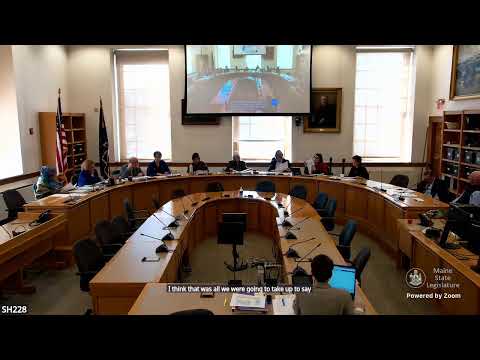
Education committee members appeared before the Appropriations Committee to present a report back on education items in the governor's supplemental budget and to highlight priorities they said deserve continued funding.
The education committee member presenting the caucus views said the caucus supported "the proposed budget for education throughout" and called for maintaining "the 55% the statewide $50,000 minimum" and for "making permanent the free community college program," along with funding for Maine Public, a bell‑to‑bell cell‑phone ban, $2 million more for education research and development and $16 million to support public preschool programs.
Why it matters: committee members said these items are central to workforce development and equity goals. Representative Holly Sergeant framed the free community college proposal as a workforce and anti‑poverty tool, saying, "It is a an incredible tool for workforce development, number one, and number two, for lifting young people out of the scourge of intergenerational poverty." She also described the committee's approach to a statewide bell‑to‑bell cell‑phone policy as including specific exceptions for health and translation needs and said a model policy would be available to guide local boards.
Debate and concerns: Republican members voiced reservations about several items. Senator James Libby said the caucus was split on parts of the budget and raised concerns about how some department funding changes were reported; he and others questioned shifting state dollars to cover federal funding gaps, including for Maine Public. He also criticized the "last dollar" design of the free community college proposal, saying it may disproportionately benefit families with more resources rather than the most economically vulnerable.
On Child Development Services (CDS), appropriations members asked whether transferring responsibility for free appropriate public education (FAPE) for 3‑ to 5‑year‑olds to school districts would create savings or duplicate labor. The education committee responded that the transfer was intended to improve service delivery rather than to generate savings, that CDS hubs will continue to support districts that lack capacity, and that the committee had received a CDS transition report and a pre‑K report to share with appropriations.
Eligibility for free community college drew additional scrutiny. Committee members described changes requested of the community college system that the presenters said reduced cost by several million dollars: a 12‑month residency requirement and reducing the completion window from four years to three. Presenters also said more than 96% of current participants are Maine high‑school graduates, though some members argued that requiring Maine high‑school graduation could exclude students with other valid Maine residency pathways.
Cell‑phone policy and implementation funding: members pressed for details about scope and costs, including whether the ban should apply on buses and how the proposed $700,000 implementation allocation would be used. Supporters said the statewide standard would establish minimum protections while allowing local boards to adopt more restrictive policies; opponents urged more evaluation of the law already passed and data on district implementation before allocating additional funds.
Next steps: the Appropriations Committee was asked to review the CDS transition and pre‑K reports and to expect fuller debate on the community college eligibility and the cell‑phone funding request when budget items come up for formal consideration.