Get Full Government Meeting Transcripts, Videos, & Alerts Forever!
Get email alerts on the Fair Housing topic
No spam. Unsubscribe anytime.
Subcommittee backs bill to codify disparate-impact fair-housing standard in Maryland
Summary
The Economic Matters CommitteeHousing & Real Property Subcommittee advanced HB573 on March 4, 2026, a bill to enshrine disparate-impact (discriminatory effect) liability in state housing law. Sponsor and civil-rights officials said the change preserves protections if federal enforcement changes; members sought clarity on enforcement and compliance.
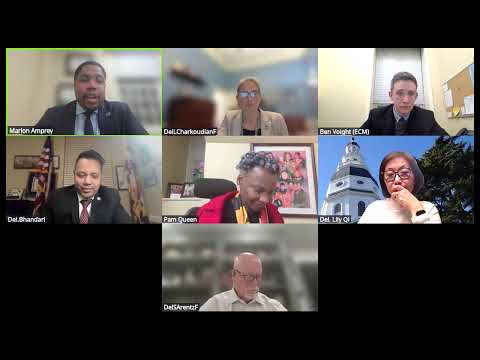
The Housing & Real Property Subcommittee of the Economic Matters Committee moved HB573, a bill to make explicit in Maryland law that housing practices that have a discriminatory effect on protected classes are unlawful even without discriminatory intent.
Sponsor Delegate Tavaris said the bill "codifies federal law at the state level," arguing that state codification is needed because federal guidance and enforcement have weakened. Committee counsel told members the bill aligns Maryland's statute with Supreme Court precedent and the existing disparate-impact analytical framework used in housing cases.
Jonathan Smith, introduced by the sponsor as director of the civil-rights office, told the panel that residents who believe they have experienced discrimination would first file an administrative complaint with the Maryland Commission on Civil Rights, which investigates and attempts conciliation; successful administrative claims may lead to litigation. "The first place to go would be the Maryland Commission on Civil Rights to exhaust your administrative remedies," Smith said.
Members pressed for practical examples and standards. Counsel and Smith said the disparate-impact route requires a robust statistical showing linking a neutral policy to a disproportionate harm to a protected group, followed by a burden-shifting analysis in which a housing provider may show a legitimate business justification and the complainant may propose less-discriminatory alternatives. Smith emphasized the evidentiary bar is high and that many cases fail at the statistical-proof stage.
Several members voiced support for preserving state-level protections if federal rules change; one member described the vote as largely along party lines. The subcommittee voted to move HB573 favorably to the full committee for further consideration. The bill, as described in committee, does not create a new administrative enforcement agency; it relies on existing Maryland processes and the Commission's investigatory authority.
Next steps: HB573 will be scheduled for full-committee consideration, where members may propose technical or compliance-focused amendments.