Get Full Government Meeting Transcripts, Videos, & Alerts Forever!
Get email alerts on the Voluntary Carbon Markets topic
No spam. Unsubscribe anytime.
CFTC climate subcommittee presses for stronger standards and transparency in voluntary carbon markets
Summary
At the Climate‑Related Market Risk subcommittee meeting, regulators, exchanges, buyers and NGOs warned that voluntary carbon markets face integrity problems — weak baselines, over‑crediting, registry gaps and social‑safeguards shortfalls — and urged disclosure, registries, core principles and enforcement before broad derivatives trading.
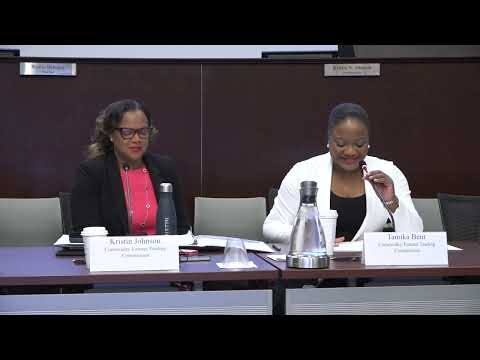
Commissioner Kristen Johnson opened the Climate‑Related Market Risk subcommittee by framing voluntary carbon markets as an area of concern for market integrity and investor protection, saying that if the markets are to remain useful they must “conform with respect to regulatory expectations” and that the CFTC should examine transaction reporting, secondary‑market rules, intermediary accountability and standardized documentation.
Panelists characterized current voluntary carbon markets (VCMs) as uneven in quality. Holly Parin (Environmental Defense Fund) said many certification standards rely on ad hoc statistical methods and incentive structures that can encourage over‑crediting; she recommended approaches such as dynamic baselines, satellite time‑series analysis and strong registries to reduce over‑crediting and improve transparency. Parin also argued that a liquid public market and regulated exchange participation can help establish reliable price signals.
Jessica Garcia (Americans for Financial Reform) and other consumer‑protection advocates urged stronger disclosure and enforcement. Garcia recommended that any final CFTC guidance require DCMs (designated contract markets) to consider leakage, additionality and permanence separately and to assess whether crediting programs implement social and environmental safeguards. She also noted California Assembly Bill 1305 and recent SEC climate disclosure rules as relevant comparators that increase transparency expectations.
Speakers representing exchanges and buyers supported market infrastructure as part of the solution but differed on operational roles. ICE noted that futures markets provide price discovery and clearing that can reduce counterparty risk if the underlying credits are well‑documented and deliverable through trusted registries. Christian Schneider (Noal Exchange) urged reliance on international standard setters (Integrity Council for the Voluntary Carbon Market/ICVCM, VCMI) rather than requiring exchanges to independently vet every crediting methodology. Buyer representatives, including the International Dairy Foods Association, said clearer accounting guidance is needed to indicate when offsets can be used toward corporate decarbonization claims.
Legal and product‑design panels highlighted classification, contracting and durability issues. Speakers discussed whether carbon credits are commodities, securities or some form of property, and how that classification affects regulatory jurisdiction. Multiple panelists recommended that self‑certification documents for derivatives include explicit statements on durability, likelihood of reversal and how reversals would affect prices and buffer accounts.
The subcommittee did not vote on rules. Members agreed to develop action items and to continue engagement with registries, standard setting bodies (ICVCM, VCMI), exchanges, and other federal agencies. Chairs signaled forthcoming working drafts and additional meetings to turn discussion into recommended guidance for the commission.