Get Full Government Meeting Transcripts, Videos, & Alerts Forever!
Get email alerts on the Crypto Fraud topic
No spam. Unsubscribe anytime.
Research traces billions from ‘pig butchering’ romance-investment scams into major crypto exchanges, professor says
Summary
Professor John Griffin told an IOSCO World Investor Week audience that his tracing study links as much as $75 billion in flows from romance-investment (“pig butchering”) scams into centralized crypto exchange deposit addresses, with 84% of on-network transactions using Tether; he urged tougher enforcement, KYT adoption and more resources to disrupt the networks.
Professor John Griffin, a finance scholar at the University of Texas at Austin, said his team’s blockchain-tracing study shows cryptocurrency flows tied to relationship‑confidence or “pig butchering” scams funnel large sums into major centralized exchanges and use Tether extensively.
Griffin presented the research during the International Organization of Securities Commissions’ World Investor Week at a panel sponsored by the Commodity Futures Trading Commission. “So, what is pig butchering? Well, it could begin with a friendly outreach like this,” Griffin said, outlining how operators build trust, induce victims to move funds to crypto platforms and then extract savings through fake or compromised trading venues.
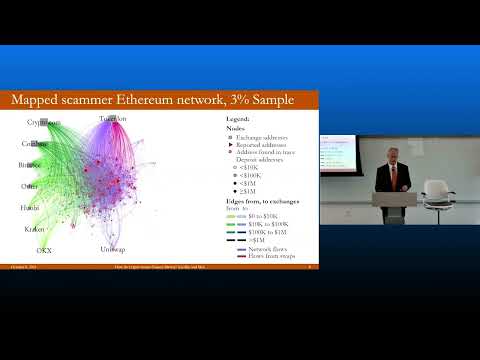
The paper traces victim addresses through the blockchain to so‑called stopping points and deposit addresses on exchanges. Griffin said his team mapped over 3,000 victim addresses, illustrated a small visual sample and reported that flows into the identified deposit addresses exceed $75 billion, with roughly $15 billion traced to outflows from Western‑based exchanges. He said 84% of transactions within the traced network were in Tether and that criminals commonly route funds through Tokenlon and then into larger exchanges such as Binance, OKX and Huobi.
Griffin described the obfuscation techniques as often basic — repeated transfers, recirculation and dusting transactions — and estimated criminals can move funds from Western to Eastern exchanges for about 87 basis points, a low cost that makes seizure difficult. He illustrated a node that routed funds through Coinbase, Tokenlon and swaps into Tether before dispersal to larger recipient nodes.
On policy responses, Griffin recommended more criminal enforcement of exchanges that facilitate money laundering, wider adoption of KYT (Know Your Transaction) in addition to KYC, better coordination for quicker asset freezes, investigation of correspondent banks that move capital to Southeast Asia, dedicated task forces, and broader public awareness campaigns. He also suggested that requiring exchanges to insure customer funds might create stronger incentives for monitoring suspicious transactions.
During a question-and-answer period, attendees pressed Griffin on how cash‑outs occur, whether traced choke points can be used to freeze funds and why Tokenlon often appears to halt traceability. Griffin said cash‑out channels are incompletely documented and may include informal laundering services, that some criminal accounts remain open long enough to be actionable, and that he could not definitively explain Tokenlon’s role but noted it repeatedly appears in their traces. He also acknowledged that some reported exchange penalties (he cited Binance’s DOJ penalties) have not ended the flows his team observed.
Melanie Devoe, Director of the Office of Customer Education and Outreach at the Commodity Futures Trading Commission, prefaced the session with a government disclaimer: the CFTC has not independently verified Griffin’s findings and the views presented do not necessarily reflect the CFTC or the federal government.
The presentation highlighted practical gaps investigators and policymakers could target — centralized exit and entry points, consolidated data sharing, and resource allocation for tracing and enforcement — and closed with calls for coordinated international action and public education.
The panel moved to audience questions after the presentation and concluded with remarks from Jorge Herrada, Director of the Office of Technology Innovation at the CFTC, who thanked Griffin and referenced recent enforcement and litigation developments involving major U.S. exchanges.