Get Full Government Meeting Transcripts, Videos, & Alerts Forever!
Get email alerts on the Solar Ordinance topic
No spam. Unsubscribe anytime.
Oliver County Planning and Zoning holds first reading of proposed solar ordinance amid accessibility complaints
Summary
At a Feb. 26 meeting the Oliver County Planning and Zoning Board completed a first reading of a detailed solar energy facility ordinance that sets permitting, setback, noise and decommissioning rules; a resident urged postponement, saying the hearing was not audible for many attendees.
The Oliver County Planning and Zoning Board on Feb. 26 completed the first reading of a proposed Solar Energy Systems ordinance that lays out permit requirements, setbacks, environmental studies, noise limits and financial-assurance rules for utility-scale and personal solar installations in the county.
The ordinance reading, presented aloud by planning staff, detailed application and siting rules including required conditional use permits for utility-scale projects, submission of site plans and environmental and noise studies, and mandatory coordination with state agencies such as the North Dakota Public Service Commission (NDPSC) and the North Dakota Department of Water Resources. The board said the ordinance will move forward in the local review process and be sent to the Oliver County Board of Commissioners for final decision.
Why this matters: The draft ordinance establishes binding standards that would govern where utility-scale solar may be located, what studies and financial securities operators must furnish before construction and how the county would manage decommissioning and road impacts. For landowners and residents in Oliver County, the rules set clear setback and mitigation expectations and create financial assurances intended to limit the risk of abandoned projects.
Key provisions described in the reading included: 150-foot setbacks from public road right-of-way; 500-foot setbacks from nonparticipating property lines and 1,500 feet from occupied buildings unless waived in writing by owners; ground-mounted systems limited to under 20 feet in height; a noise limit of 65 decibels at property lines; required environmental and watershed assessments and third-party reviews for utility-scale projects; mandatory emergency-response plans and coordination with local fire and emergency services; and financial-assurance rules requiring a construction-phase bond equal to 5% of estimated construction cost and an operational-phase assurance equal to 100% of the decommissioning cost estimate.
The reading also described permitting logistics: applicants must provide detailed site maps, proof of applicable state and federal permits, a power purchase agreement or defined GIA verifying electrical capacity, and written notification to nearby landowners and affected local boards. The draft states that conditional use permit (CUP) applications will follow the county’s public hearing rules, requiring a two-week notice published in the local newspaper before a hearing.
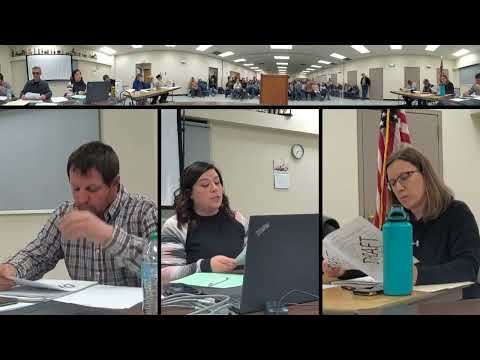
Public comment and access concerns: After the reading, Curt Swenson, who identified himself as a resident of western Oliver County and a member of the planning and zoning commission, said many people in the room could not hear the proceedings and cited attorney general guidance that public meetings be audible and accessible. "So, I'd ask that you postpone the meeting until everybody can participate as the law requires," Swenson said.
The chair acknowledged the crowd size and the audio problem, noted that copies of the ordinance were available in the back of the room, and said the ordinance will go to the county commissioners for final decision. The board agreed to take a short recess while staff retrieved a microphone and arranged seating/location to improve audibility before continuing.
What happens next: This was a first reading; no final action on the ordinance was taken. The process described in the reading requires additional permit steps, public notices and review; the ordinance as drafted would still require consideration by the Oliver County Board of Commissioners before becoming county policy.
Direct quotations in this article come from the meeting transcript; attribution in the text follows speakers’ self-identification or functional role given in the record. The text reflects only what was read and said during the Feb. 26 public meeting and does not summarize any subsequent changes or official approvals by the county commissioners.