Get Full Government Meeting Transcripts, Videos, & Alerts Forever!
Get email alerts on the Prosecutorial Oversight topic
No spam. Unsubscribe anytime.
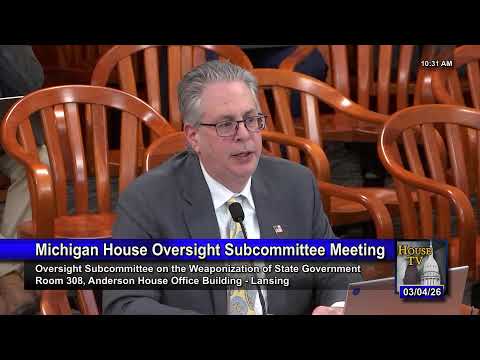
Matt DePerno tells Michigan oversight subcommittee prosecutors 'weaponized' process against him; lawmakers seek records
Summary
Matt DePerno testified before the House Oversight Subcommittee alleging Michigan Attorney General Dana Nessel improperly investigated and later prosecuted him while litigating related civil matters, raising statutory conflicts, forum-shopping and funding questions. Lawmakers requested records and signaled further oversight and possible legislation.
Matt DePerno told the Michigan House Oversight Subcommittee on Weaponization of State Government that the prosecution bringing felony charges against him grew out of civil litigation in which the Michigan Attorney General’s office had been his opposing counsel and, he said, improperly converted civil processes into a criminal inquiry.
DePerno, the Republican nominee for Michigan attorney general in 2022, told the panel on July 2 that he was indicted on July 19, 2023, on counts including undue possession of a voting machine and conspiracy, but that he has not yet received a preliminary hearing. “When the process itself becomes punishment,” he said, “targeting a political rival, an election integrity advocate, the rule of law is turned into a political weapon.”
Why the committee is watching
DePerno asked legislators to examine several structural issues he said undercut prosecutorial neutrality: the overlap between the AG’s civil representation in the Antrum County litigation and parallel criminal investigative contacts with witnesses; a recorded proffer he says omitted material transcript segments; alleged discussions by prosecutors about venue and forum selection; the appointment and funding of a special prosecutor; and grand-jury procedure in a matter that, he says, spanned multiple counties.
He cited Michigan statute MCL 49.158, which he read as barring a prosecuting attorney from prosecuting or aiding prosecution while engaged in a civil proceeding arising from the same facts. He also questioned whether the Prosecuting Attorneys Coordinating Council (PAC) had statutory authority to appoint the special prosecutor who later filed the case in Oakland County and whether the Attorney General’s department retained financial responsibility for prosecution costs after declaring a conflict.
Key disputed evidence and claims
DePerno described a recorded interview (a proffer) with investigator Michael Lynch that he said shows prosecutors acknowledged forum shopping and discussed charging strategies; he said the certified transcript omitted roughly seven minutes of that recording. He identified prosecutor names and alleged members of the AG’s office had met with and pressured witnesses while the civil case was still active.
He also flagged testimony from Jonathan Brader, then director of the Bureau of Elections, that DePerno said presented inconsistent legal foundations to a grand jury about who may lawfully possess voting equipment. “Had Jonathan Brader presented this testimony to the grand jury, no indictment would have been issued,” DePerno told the committee, asserting that later cross-examination produced testimony that undercut the grand-jury account.
Outside coordination and campaign context
DePerno said publicly disclosed materials (described in testimony as the “Arctic Frost” documents) showed communications between senior AG staff and outside groups including States United Democracy Center and the Democratic Attorneys General Association, and that internal documents circulated in August 2022 identified him by name and discussed pursuit of charges during an active campaign. He told the committee he found a reference in those materials to $3.4 million in payments reported to have supported AG-related political activity during the same period.
Committee questioning and next steps
Committee members from both parties questioned DePerno about the boundary between investigation and prosecution, whether immediate appointment of a special prosecutor would have prevented the alleged conflicts, and what statutory or appropriation reforms might be appropriate. Several legislators said they would seek records from the Attorney General’s office where permissible given the active case and explore legislation to clarify funding and appointment processes for special prosecutions.
What the hearing did not produce
The Attorney General’s office did not testify at this hearing and provided no on-the-record response to DePerno’s allegations during the session. DePerno’s claims about coordination, transcript omissions, witness pressure and funding remain allegations at this stage; committee members asked staff to request responsive records and indicated further oversight or legislative action could follow.
The subcommittee adjourned after confirming it would pursue document requests and follow-up oversight. No formal votes on policy changes were taken.