Get Full Government Meeting Transcripts, Videos, & Alerts Forever!
Get email alerts on the Education topic
No spam. Unsubscribe anytime.
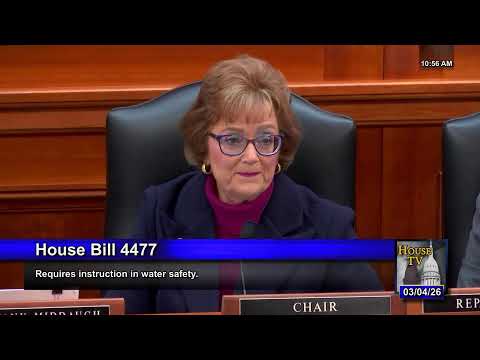
Supporters urge House panel to advance HB 4477 to require annual water‑safety instruction in Michigan schools
Summary
A witness and committee members discussed House Bill 4477, which would require annual, grade‑appropriate water‑safety education in physical‑education courses; testimony cited drowning statistics, university research on gaps in school instruction, and questions about curriculum scope and geographic customization.
A witness told the Michigan House Committee on Education and Workforce that House Bill 4477 would help protect children by establishing annual, grade‑appropriate water‑safety education in schools across the state.
"Drowning is preventable," Joseph Matulus said in testimony supporting HB 4477, citing worldwide and U.S. statistics and research on drownings in the Great Lakes. Matulus told the committee that water‑safety instruction builds knowledge and skills that reduce risk and that a coordinated, multi‑layered approach — supervision, life jackets, barriers and rescue competencies — is needed to prevent deaths.
Matulus summarized the bill as a measure to develop data‑driven, evidence‑informed and context‑specific water‑safety standards that would be required annually in physical‑education or health courses. He said the bill would also provide parents and caregivers with safety messaging and resources to support children's water‑safety learning.
The witness cited several figures in his remarks, saying more than 2.5 million people have drowned worldwide, that drowning kills "over 4,500" people in the United States annually, and that "more than 700 Michigan residents died from drowning" between the periods read in testimony (transcript language: "from 2000 or 2019 to 2023"). He also referenced the Great Lakes Surf Rescue Project, which he said reports nearly 100 drownings annually on the Great Lakes and "over 1,400 deaths due to drowning since 2010." The committee did not provide independent confirmation of those figures during the hearing.
Members asked technical and policy questions. Representative Weiss sought clarification about whether HB 4477 would require schools to provide in‑water swimming lessons or only classroom curriculum. The witness said the bill is designed to set curriculum standards and educational content (in health or PE classes) and is not written to mandate in‑water instruction statewide; local districts may offer swimming lessons where feasible.
Representative Steel asked how schools could tailor instruction by geography. Matulus, speaking from experience as a former surf lifeguard, said districts on the state’s west side might include material on rip currents while other districts emphasize river or inland‑lake safety, but core topics such as life‑jacket use, supervision and barriers would remain required.
Representative Kolazar asked a technical question about the frequency of instruction. Committee staff confirmed the bill is written so that instruction occurs every year a student is enrolled in a physical‑education course, rather than every calendar year regardless of PE enrollment.
Committee members also noted a written statement of support from Kate Dorsy of the Michigan State Medical Society; committee staff read her card but she did not speak. With no further questions, Vice Chair Linting moved to excuse absent members; there was no objection and the committee adjourned.
The hearing record shows testimony, questions and a support card rather than a formal committee vote on HB 4477. The next procedural step for the bill was not specified in the hearing record.