Get Full Government Meeting Transcripts, Videos, & Alerts Forever!
Get email alerts on the Property Tax Exemptions topic
No spam. Unsubscribe anytime.
Rep. Shy and volunteer tax advisers press bills to restore homestead and adjacent-lot exemptions for trusts
Summary
Representative Shy and Mark Marin (VITA/TCE volunteer) testified that a Department of Treasury reinterpretation removed longstanding homestead exemptions for living trusts and adjacent vacant lots; HB5235 and HB5236 would restore eligibility and help working-class retirees keep longtime tax benefits.
Representative Shy told the House Judiciary Committee on February 25 that House Bills 5235 and 5236 would reverse recent Department of Treasury reinterpretations affecting homestead property exemptions.
"The Department of Treasury has revised its interpretation of state law last year which has hit a number of working-class retirees in our state very hard," Rep. Shy said. She said many homeowners placed homes in living trusts to simplify inheritance and that the bills would explicitly qualify homes owned by living trusts for the principal residence exemption and homestead property tax credit (HB5235) and qualify vacant lots adjacent to a home for the same benefits (HB5236). "Together, these bills restore how living trusts and adjacent lots have been treated in our state for decades for tax purposes," she said.
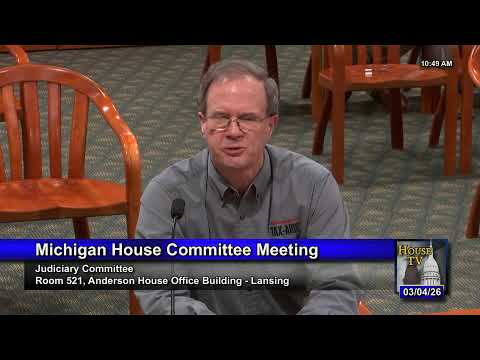
Mark Marin, a volunteer with the IRS Volunteer Income Tax Assistance (VITA) and Tax Counseling for the Elderly programs, described how a change on Treasury’s FAQ page prompted the reinterpretation and affected taxpayers who had relied on prior guidance. Marin said his Midland site processes roughly 1,500 returns and estimated the number affected at his site as "double digits but not triple digits," roughly 20 to 100 people. He said the statutory maximum property tax credit is $1,900 but that "average is somewhere around 4 to 500." Marin added that other large VITA sites operate in Detroit.
Committee members asked follow-up questions about the frequency and average monetary impact. Marin reiterated that affected returns at his site were in the tens to low hundreds and that the average credit impact was in the several-hundred-dollar range.
The testimony in support entered into the record included at least one constituent organization and individual volunteers; Chair Lightner closed the testimony period and the committee adjourned after completing business for the day.
Next steps: the committee did not take a recorded vote on these bills during this session; they remain pending for further consideration.