Get Full Government Meeting Transcripts, Videos, & Alerts Forever!
Get email alerts on the Municipal Liability topic
No spam. Unsubscribe anytime.
Alabama Supreme Court weighs whether Mountain Brook's easement duty bars municipal immunity for repeated flooding
Summary
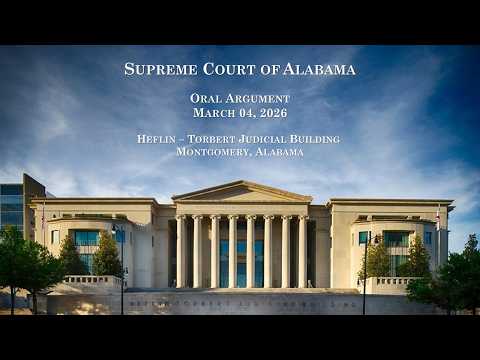
In oral arguments in SC-205293, the Supreme Court of Alabama considered whether the City of Mountain Brook can be liable for recurring flooding at 2801 Monavala Road and whether an easement holder's duty to prevent overflow defeats municipal substantive immunity; the trial court had awarded about $80,000 and a permanent injunction.
At oral argument before the Supreme Court of Alabama, lawyers for the City of Mountain Brook and homeowners Rodney and Mary Leah Miller disputed whether the city may be held liable for repeated basement flooding at 2801 Monavala Road and whether an easement-holder's duty overrides municipal substantive immunity.
Appellant's counsel Ben Presley told the court the trial judge erred by effectively imposing strict liability. He said the case turns on established precedent and the statutory authority the transcript cites as "115050 of the Alabama Code," which he said authorizes cities to construct and maintain stormwater infrastructure so long as they do not act negligently. Presley emphasized that the drainage on the Millers' property sits in a dedicated 12-foot easement and argued the proper standard is negligence, not strict liability, citing cases the city relies upon and the court's recent jurisprudence on substantive immunity.
The Millers' attorney and Mr. Miller, who represented himself at argument, said the dispute is about an easement holder's correlative duty to prevent drainage from overflowing onto adjacent property. "Every bit of water that came onto our property that day came out of their drain easement," Miller told the court, adding that the house had flooded multiple times over the prior two years and that the May 15, 2023 event produced several feet of water in the basement. Miller said the trial court found in favor of the Millers, awarding approximately $80,000 in damages and entering a permanent injunction barring the city from allowing water to flood 2801 Monavala Road in perpetuity.
The argument turned on whether the duty that arises from a recorded easement is a narrow, property-based obligation owed directly to adjacent landowners (and therefore not barred by substantive immunity) or whether liability in this context would be a design-or-construction claim rooted in policy decisions reserved to the municipality. Counsel discussed prior decisions including Batty (1974), Kennedy v. City of Montgomery, Bird, Long, and decisions the transcript characterizes as addressing substantive immunity. Presley told the court a 2021'122 engineering study by Shaw Engineering produced a three-phase plan that was estimated at roughly $3.9 million and that the city had weighed downstream impacts, costs, and citizen opposition in deciding not to proceed.
Justices questioned both sides about ownership and dedication of the drainage system, the legal distinction between negligent maintenance and design or construction, and the practicality of enforcing an injunction that would require the city to prevent all future flooding at the property. Counsel and Miller debated whether Batty's treatment of easement-based duties should remain binding or be limited in light of the court's subsequent substantive-immunity decisions.
The court took the case under submission after both sides concluded their remarks. No decision was announced at oral argument.
This dispute poses a question the Supreme Court acknowledged could affect other Alabama municipalities: whether easement-based duties create a litigation pathway for homeowners seeking damages and injunctions when municipal stormwater infrastructure overflows onto private property. The court will resolve whether such duties are compatible with the state's recent substantive-immunity framework or whether they must be treated as policy-driven design claims that immunity may shield.