Get Full Government Meeting Transcripts, Videos, & Alerts Forever!
Get email alerts on the Wastewater Infrastructure topic
No spam. Unsubscribe anytime.
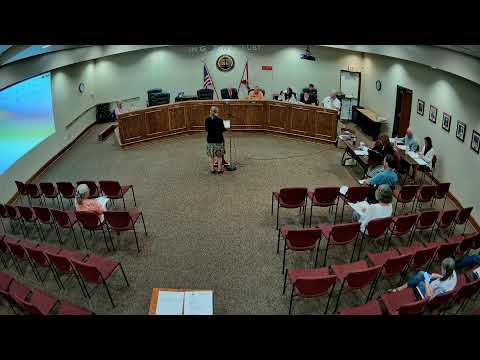
Freeport approves SRF resolution to pursue Bulldog Road wastewater plant; consultants warn near-term rate increases
Summary
After a lengthy presentation and Q&A, the City of Freeport voted to transmit an SRF planning resolution for a proposed Bulldog Road wastewater plant (phase one: 1 MGD, expandable to 3 MGD) and to adopt utility-rate adjustments to support financing. Consultants estimated phase-one capital at about $17.4 million and projected an initial sewer-rate increase of about 17% to cover debt service.
Trevor Burch, project manager with Dubberry, presented a planning study and financing plan for a new Bulldog Road wastewater treatment facility and disposal strategy, saying the work is driven by “the rapid growth that’s been going on this area.” The study recommended using the city’s 82-acre parcel for a first-phase 1 million-gallon-per-day (MGD) treatment plant and matched land-application disposal capacity, with design that can be expanded to about 3 MGD over time.
The consulting presentation laid out three alternatives and recommended the 82-acre site because it requires a smaller footprint for disposal, offered better soils and access, and—combined with a matched treatment approach—was lowest in present-worth comparisons. The first phase was estimated at about $17.4 million in capital costs; staff said some equipment (about $2.6 million) would be purchased directly by the city to capture tax savings and reduce amounts awarded to contractors.
Consultants and finance advisors (PFM and RER were referenced in materials provided to the council) described loan scenarios using the State Revolving Fund (SRF). The team said a borrow of roughly the amount shown in the planning package would be structured as a 20-year SRF loan at an assumed rate near 2.74 percent, producing annual debt service in the neighborhood of $3.96 million. The presentation tied the expected debt service to proposed sewer-rate adjustments: staff estimated an up-front FY26 increase of about 17 percent on top of the city’s normal CPI-based adjustment (roughly a $10 monthly change for a residential customer using 5,000 gallons), followed by smaller increases over the next three years before reverting to CPI-based adjustments.
Council members pressed staff and consultants on timing, disposal-site capacity and expansion sequencing. Consultants said construction bidding is expected in early 2026, awards in mid-2026 and roughly two years of construction, making mid-2028 a target for project completion of phase one if financing and approvals align. The SRF program’s competitive ranking meeting is expected in November; staff said the city must be listed by SRF to access the loan but can begin incurring reimbursable costs only after loan execution.
After questions about whether a 1 MGD start would be sufficient given rapid development, and discussion of trade-offs between building larger now versus staged expansion, Mayor Barley and council members voted to transmit the SRF planning resolution and to adopt the accompanying utility-rate resolution needed to support the financing request. The council did not provide a roll-call tally in the record beyond voice motions and “motion carried.”
Next steps: staff will finalize documents for the SRF application, submit materials ahead of the November ranking meeting, and return to council with any needed approvals tied to final loan terms and construction award decisions.