Get Full Government Meeting Transcripts, Videos, & Alerts Forever!
Get email alerts on the Healthcare topic
No spam. Unsubscribe anytime.
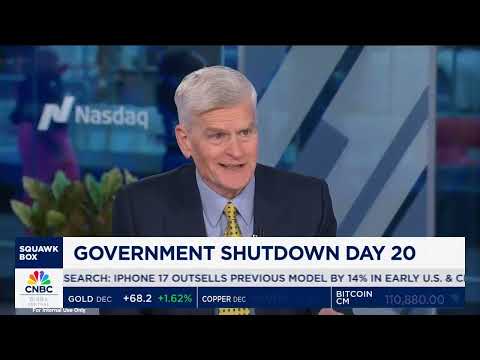
Sen. Cassidy: Shutdown risks sharp ACA premium increases unless subsidies are addressed
Summary
Sen. Bill Cassidy warned the 20-day government shutdown could lead to steep Affordable Care Act premium spikes if subsidies lapse, arguing Republicans favor lowering health-care costs through PBM reform and price transparency rather than extending subsidies without cost reductions.
Sen. Bill Cassidy, chair of the Senate Committee on Health, Education, Labor, and Pensions, said the 20-day federal government shutdown risks driving up health-insurance costs for consumers and small businesses if Affordable Care Act (ACA) marketplace subsidies lapse.
Cassidy said the immediate pressure point is the approaching subsidy deadline and described furloughed legislative staff as an obstacle to drafting fixes. He argued Republicans’ approach focuses on reducing underlying health-care costs rather than simply extending subsidies. “Republicans are proposing that we actually decrease the cost of health care, not just for the exchanges,” Cassidy said.
Why it matters: Millions of marketplace enrollees rely on subsidies to lower premiums; Cassidy warned that without an extension people could face ‘‘20% to 25%’’ increases in premiums and said previously agreed reforms could blunt those rises. He pointed to bipartisan proposals on pharmacy benefit manager (PBM) reform and price transparency as steps that would lower drug and premium costs.
Cassidy described progress on price visibility, citing the No Surprises Act, which he said he authored and co-sponsored with “Senator Hassan from New Hampshire,” as an early step toward giving patients clearer cost information. He illustrated the effect of price variation by noting that the cash price for an MRI might be roughly $600 at an outpatient facility versus about $3,000 in a hospital, saying clearer prices and patient choices can help reduce overall costs.
On state impacts, Cassidy said Louisiana’s uninsured rate fell from 16.6% in 2013 to 6.9% in 2022 after Medicaid expansion under the ACA, but he also warned that marketplace premiums in some places have risen sharply in recent years. He referenced a prior Congressional Budget Office (CBO) estimate, saying earlier bipartisan measures could lower premiums by about 11% if updated and enacted.
Cassidy also framed the political trade-offs: he said he would not vote to extend subsidies ‘‘no matter what happens’’ unless there is a deal that addresses affordability for consumers and small businesses and is sustainable for taxpayers. He urged reopening the government and resuming legislative work so staff can update previously agreed language and implement cost-lowering reforms.
On immigration and program eligibility, Cassidy asserted that state decisions and funding fungibility mean federal dollars can effectively support care for unauthorized immigrants in states that expand coverage; he also said some earlier bills sought to restrict use of federal funds for certain gender-affirming procedures. Those points were presented as part of his broader argument about what might be reintroduced in negotiations.
The interview closed with Cassidy reiterating the need to lower the cost of health care for workers, employers and taxpayers as the pathway to any subsidy extension or shutdown resolution.