Get Full Government Meeting Transcripts, Videos, & Alerts Forever!
Get email alerts on the Healthcare Policy topic
No spam. Unsubscribe anytime.
Bill Cassidy proposes shifting $26 billion in premium tax credits to prefunded health accounts
Summary
Bill Cassidy proposed redirecting roughly $26 billion now flowing to insurers under the enhanced premium tax credit into federally prefunded flexible spending accounts for exchange enrollees, saying the change would give patients control of care and reduce insurer incentives to raise premiums.
Bill Cassidy, a physician, proposed shifting roughly $26 billion a year that would otherwise flow to insurers under the enhanced premium tax credit into federally prefunded flexible spending accounts that patients control. Cassidy framed the move as a way to empower consumers and reduce incentives for insurers to raise premiums.
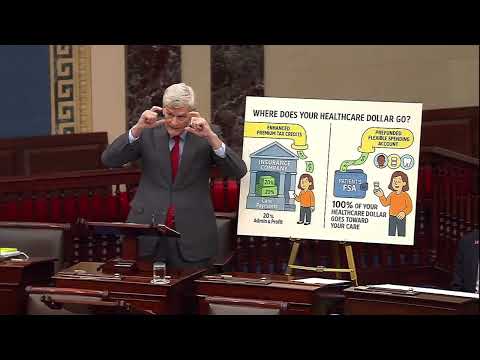
Cassidy said the enhanced premium tax credit, if reauthorized in its current form, would send about $26 billion to insurers next year and that a portion of those dollars—he cited roughly 20%—goes to administrative overhead and profit. "Let's stop writing blank checks to insurance companies. Let's invest in the patients," Cassidy said, urging colleagues to consider redirecting the subsidy to accounts that would pay for care directly.
Cassidy argued the current subsidy structure removes insurers' incentive to hold down costs because higher premiums lead to higher federal payments. He displayed charts he said show strong insurer stock performance since the Affordable Care Act and cited UnitedHealth Group as "up almost 1,200%" since 2010, using those figures to underscore his claim that insurers have benefited under the current system.
Under Cassidy's proposal, the federal government would pre-fund flexible spending accounts at a value equal to the enhanced premium tax credit an enrollee would otherwise receive. Those accounts, he said, would be spent by patients on items such as doctor visits, dental and vision care, prescriptions and preventive services, but would not be used to pay premiums.
Cassidy described the accounts as already familiar to many Americans, saying roughly 72% of people working for government entities and 47% of those in the commercial market have access to some form of flexible spending account. He said his own family uses such an account and that the model is not as complicated to implement as some opponents claim.
Cassidy noted public support for the idea from President Donald J. Trump, saying the president had posted a tweet favoring money going to patients instead of insurers. He urged senators to meet face-to-face to negotiate rather than dismissing the idea out of partisan reflex.
Cassidy acknowledged the plan would likely cost about the same as the current premium tax-credit model in the first year, but he predicted it would reduce fraud and produce savings in a second year as consumers shopped more deliberately and other reforms took effect. He framed the proposal as both fiscally responsible and a means to return purchasing power to patients.
The remarks were delivered as part of Cassidy's broader appeal to end the government shutdown by finding bipartisan agreement on healthcare and other issues. Cassidy identified himself as a doctor before yielding the floor. The speech did not include any formal motions or votes; Cassidy called for discussions with colleagues but did not identify specific legislative text or a pending amendment that he sought to put before the Senate.