Get Full Government Meeting Transcripts, Videos, & Alerts Forever!
Get email alerts on the Health Insurance Affordability topic
No spam. Unsubscribe anytime.
Senate HELP chair proposes pre-funded patient accounts to replace expiring exchange subsidies
Summary
The chair of the Senate Committee on Health, Education, Labor, and Pensions urged Congress to appropriate funds equal to enhanced premium tax credits but direct them to patient-controlled accounts to lower out-of-pocket costs and avoid a Jan. 1, 2026 coverage cliff, arguing the change would empower consumers and pressure providers to lower prices.
The chair of the Senate Committee on Health, Education, Labor, and Pensions, speaking on the Senate floor, urged Congress to replace expiring enhanced premium tax credits for Affordable Care Act exchange enrollees with pre-funded, patient-controlled accounts that would lower the cost of being insured and avoid a coverage cliff on Jan. 1, 2026.
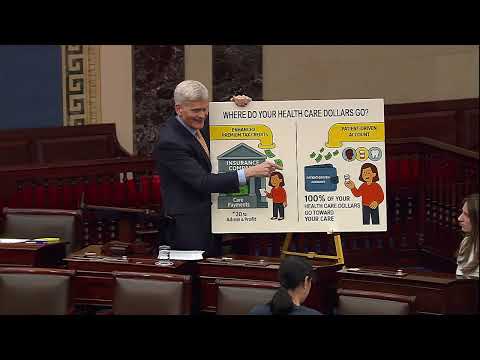
The committee chair, who said he is a physician, described seeing people who could not afford deductibles or insurance and argued that the existing approach — sending enhanced premium tax credits through insurance companies — fails to reduce underlying health-care prices. “They cannot afford their health insurance,” he said, and added, “There is no free lunch when it comes to this.”
He presented numbers he said illustrate the fiscal trend on the exchanges: taxpayers covered roughly 68% of exchange enrollee premiums in 2014, about 80% by 2020, and, he said, about 93% during the 2021–2025 period when enhanced premium tax credits were in effect. He also claimed that insurance companies take about 20% of the subsidy for profit and overhead and that those subsidies have not lowered premiums for consumers.
Faced with the approaching Jan. 1, 2026 expiration of enhanced premium tax credits, the chair framed two choices: extend the current credits (which he called a status quo that sends more taxpayer dollars through insurers) or craft a near-term, bipartisan alternative that can pass before the deadline. He gave a hypothetical example of an enrollee facing a $33,000 annual premium on a $90,000 salary if the credits lapse.
The proposal he described would appropriate funds roughly equivalent to current enhanced premium tax-credit spending but direct nearly all of those funds into accounts the patient controls—pre-funded health savings accounts or similar vehicles—rather than routing the money through insurers. “Let’s give the patient the power,” he said, arguing that a consumer making a direct price-sensitive choice would drive lower costs by choosing lower-priced providers and services.
Addressing common critiques, he said pre-funding would make accounts available across income levels and could be weighted so that lower-income people, older enrollees and families with children receive more funds. He also said the plan would not remove existing coverage or eliminate the original Affordable Care Act tax credits, characterizing the measure as a way to reduce the cost of being insured rather than cut benefits. “My plan does not take away coverage,” he said.
He urged a bipartisan approach aimed at enactment ahead of the January deadline and said the idea has the endorsement of former President Donald J. Trump. He said Republicans would broadly support the concept and that there may be elements Democrats could accept to reach a consensus.
The chair concluded by urging colleagues to act quickly and to focus on policies that lower out-of-pocket costs rather than merely increasing subsidies, then yielded the floor.