Get Full Government Meeting Transcripts, Videos, & Alerts Forever!
Get email alerts on the Cultural Resources Programmatic Agreement topic
No spam. Unsubscribe anytime.
Guam lawmakers and residents press to withdraw 2008 and draft 2025 programmatic agreements, demand full Section 106 review
Summary
At a March 5 public hearing, senators and scores of community members urged withdrawal of a draft 2025 programmatic agreement and the existing 2008 agreement governing Department of Defense projects, saying missing maps, default-approval clauses and limited public involvement put Chamorro cultural resources at risk; the hearing was continued to March 11 for follow-up.
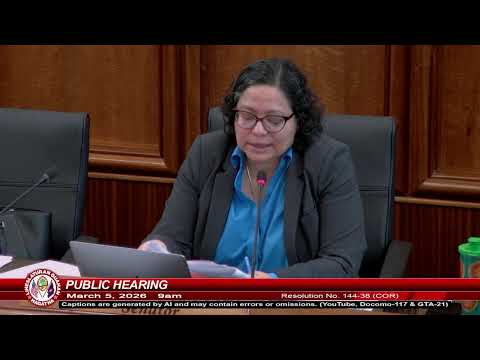
Guam — On March 5, 2026, the Guam Legislature held a public hearing on Resolution 144‑38 in which senators and community members urged the withdrawal of a draft 2025 programmatic agreement and the 2008 programmatic agreement that govern Department of Defense undertakings on Guam and demanded full implementation of the National Historic Preservation Act’s Section 106 review process.
Senator Sabina Flores Perez, who introduced the resolution, framed the measure as “about agency” and said it seeks to ensure “meaningful consultation and full legal protection of our cultural resources under federal law.” She told the panel that the draft 2025 agreement expands DoD coverage, allows categorical procedures that reduce project‑specific review, and omits meaningful public participation and required appendices such as archaeological sensitivity maps.
Multiple witnesses described the same core complaints in different terms. Jarren Saru pointed to missing appendices, saying the draft “excludes Appendix B and C maps” and calling that exclusion “a red flag.” Monica Flores, executive director of Pertahi Guhan, said her organization has repeatedly requested the missing material and that the absence of full documentation prevents “free, prior and informed consent.”
Speakers argued that procedural provisions in the draft — and in the longstanding 2008 programmatic agreement — could allow automatic approvals or short notice that bypass customary protections. Baltazar B. Ugen testified the agreement amounts to “a pre‑authorization for the erasure of our history,” and flagged stipulations that make the Joint Region Marianas commander the final authority on disputes. Several witnesses and senators also raised the draft’s 72‑hour notice provision and a 30‑day default approval mechanism as specific risks to archaeological sites and burials.
Experts and community advocates urged stronger, site‑specific Section 106 reviews instead of broad programmatic coverage. Ian Catling recommended adopting standards like those applied under NAGPRA and establishing independent cultural monitors on work sites to verify findings and ensure proper treatment of human remains and artifacts.
Senators asked questions and debated policy responses at length. Senator Chris Barnett said the draft appears written to streamline construction timelines “for the Department of Defense” rather than to protect Chamorro resources, and urged greater legislative engagement and civic participation. Senator Telot Taidigui highlighted the lack of a public accounting for the 2008 agreement’s outcomes — no comprehensive report on projects, sites disturbed, or disposition of remains — and said the draft’s missing documentation and ambiguous scope require withdrawal and reworking.
No formal vote was taken at the March 5 session. Chair Sabina Flores Perez announced the hearing will continue on March 11, 2026, at 2:00 p.m. to allow the State Historic Preservation Officer (SHPO) and other officials to respond and to permit additional testimony.
Why it matters: Witnesses and several senators argued that programmatic agreements, if written or implemented without strong safeguards and public oversight, can substitute expedited mitigation or data recovery for avoidance and meaningful consultation. For Guam’s advocates, that means potential, irreversible loss of archaeological sites, burial places and cultural landscapes of ongoing significance to Chamorro people.
What’s next: The committee recessed the hearing to March 11 at 2 p.m. and invited additional written testimony; senators signaled interest in legislation to require public reporting, mandate public review procedures for Section 106 undertakings, and consider reassigning oversight roles currently vested in SHPO.
Quotes (selected)
“Resolution 144‑38 is about agency. It is about whether we assert our right to meaningful consultation and full legal protection of our cultural resources under federal law,” said Senator Sabina Flores Perez, the measure’s sponsor.
“It appears the draft excludes Appendix B and C maps — that’s a red flag,” said Jarren Saru, who urged the legislature to demand the missing material be released.
“This agreement is effectively a pre‑authorization for the erasure of our history,” testified Baltazar B. Ugen, who flagged clauses that make the military commander the final arbiter of disputes.
“We have records of communication with SHPO asking for archaeological reports that were not granted,” Monica Flores, executive director of Pertahi Guhan, told the committee.
The hearing was recessed; the committee will reconvene March 11, 2026, at 2 p.m.