Get Full Government Meeting Transcripts, Videos, & Alerts Forever!
Get email alerts on the Water Systems topic
No spam. Unsubscribe anytime.
Peaks Mill water district warns rates and consolidation likely as costs and regulation bite
Summary
Peaks Mill Water District officials told the Fiscal Court that aging pipes, high water loss and new lead-service rules have pushed the small system toward steep rate increases and left consolidation, sale or shared services among the only sustainable options for 1,250 customers.
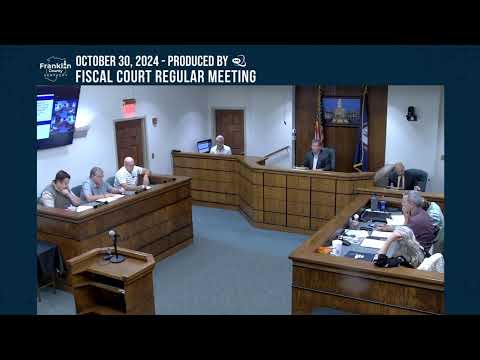
Peaks Mill Water District officials told the Franklin County Fiscal Court on Oct. 30 that the small system faces rising costs, regulatory pressure and persistent water loss that together make operating as a standalone utility unsustainable.
Greg Heitsman, a consultant advising the Peaks Mill board, said the district’s aging infrastructure and non-revenue water — roughly 25% leakage plus about 20% of water used for required flushing — have driven operating deficits. "As a standalone entity Peaks Mill water district is not financially feasible long term," Heitsman said.
Heitsman summarized options the board is considering: a rate increase, consolidation or shared services with neighboring systems, or sale to a larger investor-owned company. He said a cost-of-service study recommended a roughly 21% rate increase; the Kentucky Public Service Commission’s analysis indicated a roughly 28% increase. "We went from roughly a $48 per month average bill for 4,000 gallons to over $60," Heitsman said, acknowledging the impact on customers.
The presentation described compliance with the federal and state lead-and-copper requirements as an added cost driver. Heitsman said the district must complete a service-line inventory and that any lines coded "unknown" are treated as if they could be lead for regulatory purposes. He estimated the field work to confirm a sample of unknowns would cost "something like $60,000–$70,000" for Peaks Mill.
Members asked whether the district or property owners would pay to replace lead service lines. Heitsman said the public portion (the line from the water main to the meter) is the district’s responsibility; replacement of the private portion traditionally fell to property owners, though federal funds and new grant rules can in some cases be used to assist private-side replacements.
Heitsman and others outlined consolidation mechanics and trade-offs. Acquisition by Kentucky American Water would typically lead to eventual equalization of rates across its service area; that could reduce Peaks Mill rates over time but requires a formal acquisition process. Shared-service models — for example, shared operations staff, equipment or a combined general manager — could extend the interval before another rate increase is needed.
Officials also described broader funding options. Heitsman said Kentucky recently authorized a roughly $150 million program (split across budgets) aimed at troubled small systems; eligibility for some state grant/loan programs can improve if systems consolidate or demonstrate partnership arrangements.
The Peaks Mill board has not made a final decision. Heitsman said the board retained consultants, ran a rate study and held public meetings in March and July; the board meets regularly and intends to explore consolidation, shared services and targeted capital projects while seeking grant funding.
Next steps: Peaks Mill will continue public engagement and board deliberations; the district meets monthly (second Monday). County officials encouraged residents with concerns to attend board meetings and watch for notices about potential mergers, rate adjustments or grant-seeking activity.