Get Full Government Meeting Transcripts, Videos, & Alerts Forever!
Get email alerts on the Tourism Commission topic
No spam. Unsubscribe anytime.
Franklin County discusses creating Sports Tourism Commission; officials debate budget, oversight and tax use
Summary
Franklin County Fiscal Court held a lengthy first-reading discussion on ordinances to withdraw from the joint tourist commission and create a county Sports Tourism Commission focused on sports tourism; commissioners raised questions about seed funding, annual budget approval authority, and effects on the existing tourist commission's roughly $295,000 annual revenue.
Franklin County Fiscal Court on Dec. 11 heard first readings of two ordinances to withdraw the county from its joint tourist commission with the city and to create a separate Franklin County Sports Tourism Commission to focus on sports-related tourism.
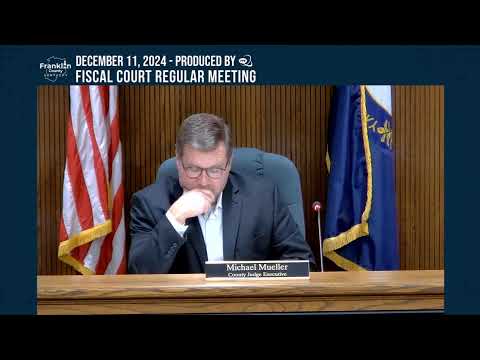
Judge Muller opened discussion and invited Eddie Jones to explain the proposal. "This ordinance essentially creates a new convention visitors bureau . . . the county will have one and the city will have one," Jones said, outlining a seven-member board and statutory membership rules that require representation from the hotel and restaurant industries. Jones projected the county CVB could generate "about $600,000 a year" under the proposed structure.
Why it matters: commissioners said the change could steer more resources to sports-related events and facilities—tournaments, multi-field complexes and related amenities—which proponents said draw out-of-area visitors who pay hotel and restaurant bills. But several commissioners pressed for clarity about oversight, initial funding and whether the Fiscal Court could meaningfully approve or reject the CVB's annual budget.
Robin Antonucci, executive director of the Franklin County Tourist Commission, told the court the county commission currently receives transient-room taxes totaling about $295,000 for fiscal 2024 and urged collaboration: "we are fully in support of sports tourism . . . we want to work with you." She warned that splitting the joint commission would have an immediate budget impact for the existing tourism office unless interlocal agreements preserve city and commission revenue streams.
Commissioners asked for specific guardrails and milestones. Squire Sebastian and others discussed a multi-step process: create the county CVB, adopt a revenue plan, negotiate an interlocal agreement with the city about shared projects and, later, negotiate an agreement between the county and the new sports commission about program details and bonding. The court discussed statutory constraints: an additional 2% special tax for convention or fine-arts projects must be used for debt service and generally tied to facilities in the central business district.
On oversight, Jones and attendees said the Fiscal Court's primary leverage is the authority to stop charging the tax; commissioners sought clearer wording in the revenue plan about whether the court would "approve" or merely "receive" the CVB's annual budget and whether the court could refuse additional funding requests. Jones said the annual budget submission provides an annual public forum: the commission would present its plan and the Fiscal Court could decide whether to continue the tax.
Next steps: both ordinances and the revenue plan were presented as first readings; no final votes were taken on those items at the Dec. 11 meeting. Officials said detailed interlocal agreements and an escrow arrangement for convention-center funding remain to be negotiated before any funds are transferred or bond decisions are finalized.
What to watch: whether the court amends language about budget approval and requests for funds, how the parties handle the immediate budget gap for the existing tourist office, and the content of forthcoming interlocal agreements that will specify project eligibility, bond terms and how county and city CVBs will coordinate spending.