Get Full Government Meeting Transcripts, Videos, & Alerts Forever!
Get email alerts on the Planning Zoning topic
No spam. Unsubscribe anytime.
Fiscal Court orders evidentiary hearing after contested first reading of Cardwell Lane rezoning
Summary
After public commenters urged delay and magistrates raised gaps in the Planning Commission record (traffic study, sewer capacity), Franklin County Fiscal Court voted to hold an evidentiary hearing on a proposed zone-map amendment for 827 Cardwell Lane.
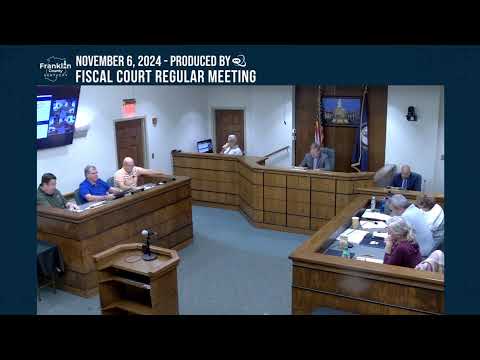
Franklin County's Fiscal Court voted on Nov. 6 to hold an evidentiary hearing for a contested zone-map amendment that would reclassify roughly 25.4 acres at 827 Cardwell Lane from Rural Residential (RB) to Rural Low-Density Multifamily (RL).
Ben (court staff) summarized the application for Cardwell 827 LLC and said the Planning and Zoning Commission closed public testimony on Sept. 12, 2024. Several magistrates said the packet lacked key supporting materials: Squire Sebastian said he could not find a traffic study referenced repeatedly in prior meetings, and others noted uncertainties about sewer capacity and the relationship of parcels shown on the concept plan to the area included in the rezoning request.
Public commenters raised similar concerns. Chris Shimer, who said he served on the comprehensive-plan advisory committee, told the court the public had rejected an industrial park on the county line during the plan process and urged the court to "halt until the plan and its future land-use map is official." Larry Arnett said residents on the southern end of the county "do not want an industrial park there" and asked the court to postpone a decision.
Judge Muller said he had read the record and the staff materials but the court must balance the record against citizens' requests for the opportunity to speak. After an initial motion to decide the matter on the Planning Commission record failed, the court voted in favor of scheduling an evidentiary hearing that will take sworn testimony and allow the court to make its decision based on that record.
Next steps: A date for the evidentiary hearing will be set and public notice provided; staff and counsel were asked to ensure the court has any missing materials (traffic study, sewer analyses) in advance.