Get Full Government Meeting Transcripts, Videos, & Alerts Forever!
Get email alerts on the Broadband topic
No spam. Unsubscribe anytime.
Regional broadband official outlines state BEAD scoring, urges local coordination
Summary
Bluegrass Area Development District deputy director Shane New briefed Franklin County officials on BEAD/NTIA timelines and scoring, saying application quality and provider coordination matter more than local funding but urging magistrates to prepare for provider outreach and pole/utility coordination.
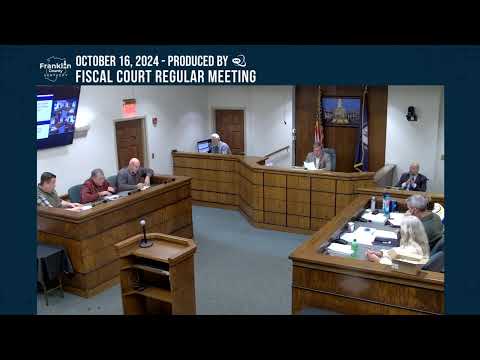
Shane New, deputy director of the Bluegrass Area Development District, told Franklin County Fiscal Court on Oct. 16 that the upcoming BEAD (Broadband Equity, Access, and Deployment) funding rounds will largely be decided by application scorecards and ISP proposals, not by county grant applications.
"My name is Shane New. I'm the deputy director of Bluegrass Area Development District," New said as he opened a technical briefing on mapping, scoring and local roles. He described a 100‑point state scorecard where "35 points of the 100 points is based on" how many serviceable locations an ISP proposes, and roughly 30 points prioritize affordability and cost per customer.
New said the pre‑qualification process concluded in September and that, in almost all cases, ISPs—not counties—are the entities submitting BEAD applications. He advised local officials to be "supportive of anything that's coming your way" from providers and to organize regular coordination meetings for pole acquisitions and utility negotiations, which often determine how quickly projects proceed.
County leaders pressed New on mapping and equity. New acknowledged the state's mapping is still being consolidated and said the program uses census block groups to divide eligibility, a process that has led some providers to delay local meetings until the state submits finalized maps to NTIA for review.
Several magistrates urged the court to consider contractual guarantees or local match for remote areas that might be ignored once "low‑hanging fruit" is taken by early applicants. New cautioned that while local money demonstrates "skin in the game," it generally does not translate into additional points on the state scorecard beyond coordinated engagement.
The court heard that BEAD awards include a multi‑year implementation window; New said awardees generally will have four years to complete buildout with a possible one‑year extension. He pointed to Scott County as an example where years of coordinated work brought near‑countywide coverage but required sustained effort and time.
The judge and magistrates asked the Bluegrass AD to provide the public link for residents to check mapping eligibility and to continue helping the court identify which providers plan to apply for Franklin County. No formal vote followed the presentation; the court acknowledged the need to prepare procurement, pole access and community engagement plans ahead of provider proposals.