Get Full Government Meeting Transcripts, Videos, & Alerts Forever!
Get email alerts on the Campaign Finance topic
No spam. Unsubscribe anytime.
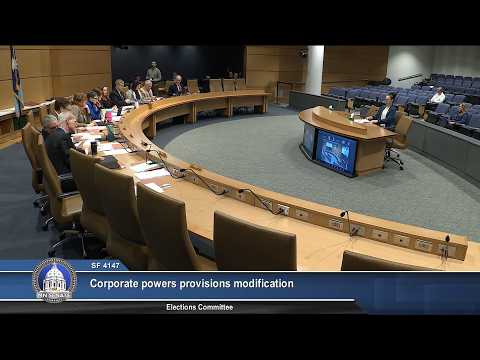
Senate Elections Committee backs bill to bar corporate spending in Minnesota elections; sends measure to Judiciary 6–5
Summary
The Senate Elections Committee voted 6–5 to recommend Senate File 41-47, which would remove statutory political-spending powers from corporate entities and require greater disclosure of outside spending. Supporters said the change would curb 'dark money'; opponents warned of constitutional risk and costly litigation.
A Minnesota Senate committee on March 10 recommended passage of a bill that would strip corporate entities of the statutory power to spend in elections and push political spending through disclosed campaign committees.
Senate File 41-47, introduced by Sen. Bolden, cleared the Senate Elections Committee on a 6–5 roll call and was referred to the Judiciary Committee. The bill’s sponsors described it as a state-law pathway to blunt the influence of undisclosed outside spending that has grown since the U.S. Supreme Court’s 2010 Citizens United decision.
Supporters said the measure restores transparency and centers electoral influence on natural persons. Eric Petry of the Brennan Center for Justice told the committee that Citizens United and subsequent developments enabled Super PACs and dark-money groups to flourish; he cited national figures showing a sharp rise in outside spending in recent cycles. David Fischer of Clean Elections Minnesota told the panel that outside spending rose markedly after Citizens United and said the bill leverages the state’s chartering power to limit corporate spending powers.
Opponents warned the bill could prompt litigation and impose collateral costs. Brian Cook of the Minnesota Chamber of Commerce said the proposal raises substantial constitutional questions and could sweep in nonprofit advocacy; he noted the state’s recent litigation connected to House File 3 and the federal injunction that produced legal expenses requiring a roughly $760,000 appropriation to the Campaign Finance and Public Disclosure Board.
Committee members pressed witnesses on mechanics and scope. Sponsors and some witnesses said the bill targets "legal entities" and would not prevent natural-person donors from giving to Super PACs; instead, proponents said the bill increases disclosure by making corporate-origin spending subject to statutory limits tied to corporate charter powers. Opponents said that approach is legally novel and likely to be challenged in court, potentially exposing the state to legal costs if the measure were struck down.
The committee also adopted several authors’ and technical amendments before the vote. Sen. Bolden moved the committee recommendation; the roll call produced six ayes and five nays, after which the chair announced the bill is recommended to pass and referred to the Judiciary Committee.
The next step is consideration by the Judiciary Committee, where legal and constitutional questions are expected to be a principal focus.