Get Full Government Meeting Transcripts, Videos, & Alerts Forever!
Get email alerts on the Neuroinclusion topic
No spam. Unsubscribe anytime.
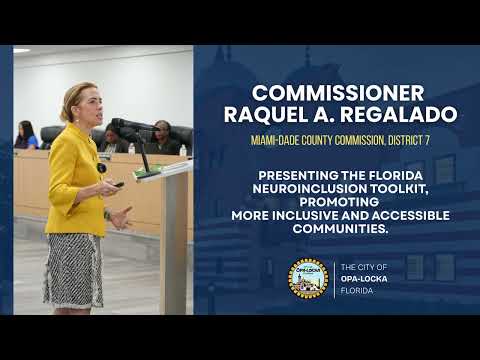
Miami‑Dade commissioner presents neuroinclusion toolkit to City of Opa‑locka commission
Summary
Miami‑Dade County Commissioner Raquel Regalado presented a free Florida Neuroinclusion Toolkit and urged Opa‑locka to adopt low‑cost measures — from first‑responder training and decals to sensory rooms and transit lanyards — to make city services more accessible for neurodiverse residents.
Miami‑Dade County Commissioner Raquel Regalado spoke to the Opa‑locka City Commission on April 8, 2026, presenting the Florida Neuroinclusion Toolkit and urging municipal leaders to adopt straightforward accessibility measures to better serve residents with autism and other neurological differences. "One out of five individuals in Florida is neurodiverse," Regalado said, and described the toolkit as a free resource for policy makers with an appendix that includes drafted legislation, data and program materials.
Regalado summarized Miami‑Dade County’s multi‑year effort to train municipal staff and first responders, saying the program has trained roughly 4,100 first responders and expanded training to libraries, transit and parks staff. She described a voluntary registry and decal system that lets caregivers register information for 911 responders and request decals for homes and vehicles so responders know there may be a resident with special needs at the address. "When you call 911, you put your information on the website — whether the individual is verbal or nonverbal and recommended de‑escalation tools," Regalado told the commission.
She outlined practical tactics that municipalities can implement without creating new agencies or large budgets: social stories and sensory maps for events, on‑site sensory rooms or mobile sensory units for festivals, dimmed lights and reduced sound for special movie showings, sunflower lanyards for transit staff to recognize hidden disabilities, and "neuroinclusive government days" for services such as ID issuance. Regalado said Miami‑Dade also runs a program at MIA called MIA Air that provides a dress rehearsal for people on the autism spectrum to practice airport procedures.
Regalado cited workforce and drowning‑prevention initiatives as additional benefits of the county program: she said departments including libraries, housing and water/sewer are actively recruiting neurodiverse employees and that the county amended a zero‑drowning initiative to include autistic adults and fund swim instruction and internships. "You don't have to hire outside consultants — the toolkit shows how to start with what you already have," she said.
Commissioners thanked Regalado and asked about outreach and school programs; Regalado offered to coordinate virtual and in‑person trainings, school talks and community task forces. No formal action was taken by the Opa‑locka commission on the toolkit at this meeting; Regalado said she is available to help municipal partners implement the model.
The presentation ran from the commission’s recognition of Miami‑Dade’s model through a question period and concluded before the meeting moved to agenda items.