Get Full Government Meeting Transcripts, Videos, & Alerts Forever!
Get email alerts on the State Budget topic
No spam. Unsubscribe anytime.
DHS forecast shows rising Medicaid costs, flags HR1 effects and federal funding risks
Summary
The Department of Human Services told the House Human Services Finance and Policy Committee that Minnesota’s FY26 DHS budget is about $28 billion, with Medicaid growth driven by utilization, managed‑care rate resets and waiver spending; the forecast incorporates some HR1 changes but excludes provisions requiring state law, and it omits uncertain federal withholds and deferrals that could materially affect the budget.
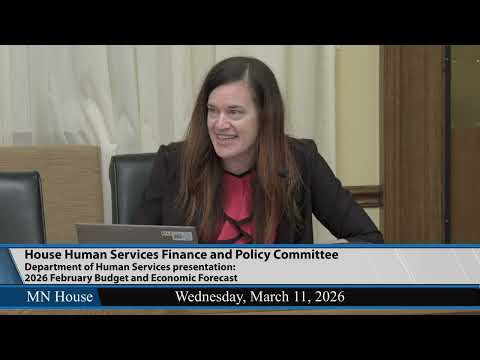
The House Human Services Finance and Policy Committee heard a Feb. forecast briefing from Alice Bailey, budget director for the Minnesota Department of Human Services, who told lawmakers the agency’s FY26 budget is roughly $28 billion, about $15 billion of which comes from federal funds.
Bailey said roughly $10.6 billion is in general‑fund programs and about $1.3 billion stems from the Health Care Access Fund. She told the committee that nearly 95% of DHS spending is programmatic and that administrative budgets remain around 2–3% of the total, a level she described as strained given rising program demand.
The presentation traced Medicaid growth to two core factors: more people receiving services and rising average costs. ‘‘We’re serving more people and average costs are going up over time,’’ Bailey said, pointing to increased use of home- and community‑based services and higher managed‑care payments. She said actuarial resets required by the Centers for Medicare & Medicaid Services led to significant managed‑care capitation increases and that pharmacy costs have been a notable driver.
Bailey explained the November forecast showed a large general‑fund increase (about 7.6%, or $1.4 billion) driven in large part by managed care rate adjustments; February updates produced smaller changes after recent data updates and timing shifts. She described prepayment review timing that shifts roughly $53 million in payments between biennia and noted ongoing reductions in submitted and approved claims tied to that review process.
On HR1 implications, Bailey said the forecast includes some HR1 provisions — for example, changes to retroactive coverage months and eligibility for certain lawful‑immigrant categories — but does not incorporate work‑requirement or cost‑sharing items that would require state statute. ‘‘Those items need state law changes,’’ she said, so their cost and programmatic effects are not reflected in the forecast.
Bailey also warned the committee of material federal risks that the forecast does not assume: a federal notice of potential quarterly withholds of $515 million and a separate deferral notice of roughly $259 million in one quarter. ‘‘Those are not in this forecast because we’re awaiting CMS review and timing,’’ she said, calling both a significant budget risk if they are realized.
Committee members pressed DHS on administrative funding, CMS’s ‘‘stop‑the‑clock’’ review process for state plan and waiver amendments, and how rate add‑ons and retroactive approvals would flow to providers and wages. Bailey said CMS questions can pause the statutory 90‑day review clock and that several amendments remain ‘‘stopped,’’ delaying implementation and retroactivity.
The committee moved to questions after the briefing; Bailey stood for questions on enrollment adjustments, the mechanics of the prepayment review, and the plan for implementing HR1‑related operational changes (including anticipated administrative costs to assist counties with increased workload). The department said it will return with more detailed itemizations, including which amendments are stopped and the monthly fiscal impacts.
The hearing record shows the forecast presents a modest near‑term improvement relative to prior estimates once timing and prepayment effects are considered, but DHS told the committee that several large downside risks remain unmodeled and could substantially change the state’s fiscal outlook.