Get Full Government Meeting Transcripts, Videos, & Alerts Forever!
Get email alerts on the Blue Economy topic
No spam. Unsubscribe anytime.
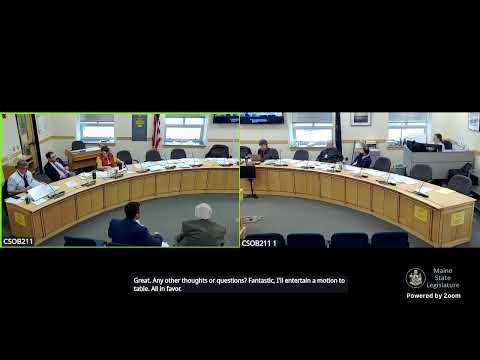
Lawmakers table plan for a Maine Blue Economy Center, ask for clearer goals and membership
Summary
A stakeholder draft of LD2216 would create a Maine Blue Economy Center to coordinate research, workforce development, investment attraction and data for ocean-based industries. Lawmakers asked for clearer performance metrics, an ocean-economy database, explicit representation for commercial fishing and recreation/tourism, and a concrete budget/staffing plan; the committee tabled the bill pending a consolidated draft.
The committee considered a stakeholder strike‑and‑replace for LD2216 to create a Maine Blue Economy Center to accelerate ocean-related innovation, workforce development and investment attraction. Stakeholders said the center should be built on the Life Sciences Innovation Center model but explicitly include legacy marine industries — commercial fishing, working waterfronts and marine recreation/tourism — and provide an ocean‑economy database to baseline and track economic activity.
Mike Conneathan (Upwell Collaborative), who helped manage the blue‑economy task force, told the committee that the substitute amendment updates the Life Sciences template for ocean-sector priorities and restores representation for legacy industries: "We can't talk about an ocean economy in the state without including perspective from those industries," he said.
Committee requests and concerns
Lawmakers pressed for three concrete elements before voting: (1) a clear definition of the blue economy and measurable performance targets (market size, revenue goals, workforce metrics and measurable return on investment), (2) a precise membership list with stronger private‑sector and commercial‑fishing representation, and (3) a realistic budget and staffing plan that matches proposed activities (data/analysis, grant coordination, workforce pipelines and outreach). Several legislators asked that any interim report timeline be shortened so the new board delivers a practical strategic plan quickly.
Representative Tracy Gear asked the center to present a tracking model for economic opportunities and measurable steps for turning federal and philanthropic opportunities into Maine investments. Representative Art Mingo asked that the bill explicitly reference lobstering and other live fisheries so those industries are protected as the center pursues new sectors.
Outcome
Committee members agreed the draft needed consolidation and additional specificity. They asked staff to return a single updated substitute that incorporates the day’s amendments (including added representatives for recreation/tourism and commercial fishing, a blue‑economy definition, and a 60‑day interim report timeline after board appointments) and a line‑item budget for staffing and initial programming. The committee tabled the bill pending that consolidated language.