Get Full Government Meeting Transcripts, Videos, & Alerts Forever!
Get email alerts on the Building Codes topic
No spam. Unsubscribe anytime.
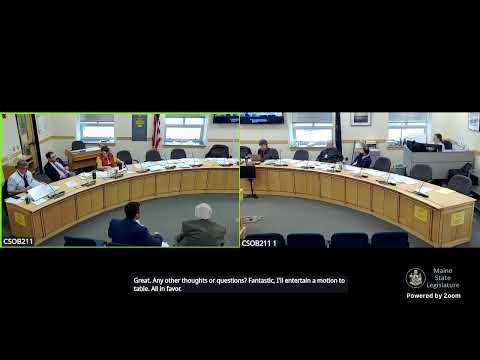
Maine committee advances building-code reforms, rejects immediate deed‑fraud statute
Summary
In work sessions the committee declined to advance a statutory seller‑identity mandate (LD2182), adopting 'ought not to pass' and requesting further coordination, while moving LD2224 and LD2225 forward with technical amendments to reduce residential construction costs and improve code adoption and enforcement. Members pressed for more study of sprinkler costs and careful calibration of elevator and smoke‑partition rules.
The committee’s work sessions on March 11 took up multiple bills affecting construction, code enforcement and fraud prevention.
LD2182 — deed‑fraud prevention
The commission charged with recommending methods to prevent deed fraud proposed a statutory requirement that sellers’ identities be verified by real-estate licensees and settlement agents. First American Title and other title-industry witnesses urged caution, noting a Uniform Law Commission draft on deed fraud is in progress and recommending that Maine defer prescriptive, statutory steps until that model law is available. Director Penny Valancort of OPOR told the committee that licensing boards already have statutory authority and existing minimum standards of practice that can be used while model law work continues.
After discussion the committee voted 'ought not to pass,' unanimously of members present, and asked staff to send letters urging continued interagency coordination and to monitor the ULC drafting work.
LD2224 and LD2225 — building-code changes and municipal enforcement
LD2224 includes provisions to adopt the 2025 NFPA National Fire Alarm and Signaling Code and directs the State Fire Marshal to convene a working group to study residential fire sprinklers and paths to lower costs. The committee accepted MOCHA’s technical strike‑and‑replace language to avoid statutory code “lock‑ins,” and added an affordable‑housing representative to a technical board.
Chamber and builder representatives urged broader adoption of working-group recommendations (including single‑stair egress), while the State Fire Marshal cautioned against removing safety features without data; the marshal said smaller elevators may save limited construction cost but raised concerns about EMS access and stretchers. The committee voted 'ought to pass as amended' and directed the State Fire Marshal and MOCHA to carry out the convening and reporting called for in the bill.
LD2225 added off‑site construction standards (I.C.C. MBI 1200) to the state code list, required industrial‑housing training for code officers and authorized a three‑year pilot for regionalized code enforcement. The committee adopted technical edits and voted 'ought to pass as amended.'
What the committee asked for next
Members requested that working groups return specific cost and safety analyses for sprinklers and elevators, and asked MOCHA and the State Fire Marshal for concrete recommendations and a clear timeline for any rule changes.