Get Full Government Meeting Transcripts, Videos, & Alerts Forever!
Get email alerts on the Housing Industrialized topic
No spam. Unsubscribe anytime.
Maine committee hears bills to boost factory-built housing and ease financing for manufactured-home owners
Summary
Lawmakers heard detailed testimony on two bills: LD2230 would provide incentives, technical partnerships and workforce training to expand industrialized (factory-built and modular) housing; LD2231 would change titling and mediation rules to help owners of manufactured and tiny homes access mortgage financing and clarify lot-rent mediation procedures. Supporters said the measures would increase supply and affordability; some lenders and housing groups asked for technical changes; realtors warned of unintended consequences for transactions and urged caution.
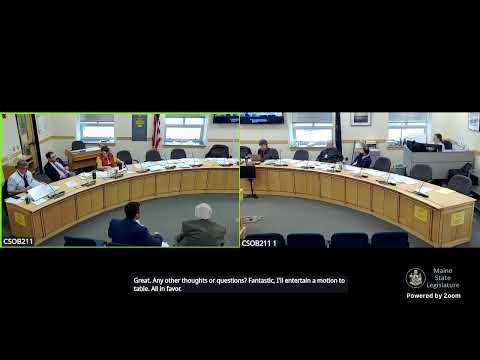
The Joint Standing Committee on Housing and Economic Development held public hearings March 11 on two bills aimed at making more housing available in Maine through factory-built construction and by easing financing barriers for owners of manufactured and tiny homes.
LD2230: industrialized housing incentive and partnerships
Senator Chip Curry opened the hearing on LD2230, saying the bill packages recommendations from the housing production innovation working group to test and scale industrialized construction methods to reduce costs and accelerate timelines. "Innovative construction approaches such as modular and other forms of industrialized housing have the potential to reduce cost and shorten construction timelines," Curry said.
Phoenix McGlaughlin, director of strategy and implementation at the Department of Economic and Community Development, told the committee that factory-built components can lower per-unit costs when manufacturers reach sufficient scale. McGlaughlin described three primary bill elements: a per-unit incentive for manufacturers producing and installing housing in Maine; a public–private extension partnership to provide technical assistance and workforce certification; and a prize competition to encourage innovation. The department asked that per‑unit incentives be delivered as grants rather than loans because administering loans would add underwriting burdens and staffing requirements.
Committee members pressed McGlaughlin on the $1,500–$6,000 per-unit incentive range and on how community colleges would be recruited to provide training for off-site construction skills. McGlaughlin said the figures were informed by a Colorado program and prior draft bond language and that extension partnerships could help community colleges adopt new curriculum components for off‑site construction.
Hillary Gove with MOCHA (housing opportunity program) supported the bill’s incentives but recommended removing two sections that would require MOCHA to adopt rulemaking to define income tiers and grant eligibility, arguing program statements already handle those details.
Becky Smith of the Maine Community College System said colleges are prepared to work with vendors and build short‑term training or credentialing to support industrialized housing if funding for facilities and equipment is available.
LD2231: titles, inspections and lot-rent mediation for manufactured and tiny homes
Representative Tracy Gear presented LD2231 as a companion initiative from the same working-group process. The bill would authorize the attorney general to enforce community and park standards, require infrastructure inspections by a professional when institutional purchasers acquire a manufactured housing community, clarify notice and mediation procedures for proposed lot‑rent changes (tying eligibility to the CPI-based threshold), and enable homeowners to change the legal status of their manufactured or tiny homes to real estate even when they do not own the underlying land so they can access mortgages.
Jennifer Corbett, vice president of retail lending at Norway Savings Bank, testified that treating manufactured homes as real property (instead of chattel) paves the way for more traditional mortgage products, lower interest rates and longer terms. "Titling or recording the manufactured home similar to real estate will create a more stable and transparent ownership structure," she said, noting differences in monthly payments she has seen between personal-property loans and mortgage finance.
Greg Payne, the governor’s senior adviser on housing policy, said the administration strongly supports LD2231, highlighting provisions requiring third‑party infrastructure inspections of parks upon sale and clarifications to last year’s laws.
Concerns and clarifications
Andy Kashman, representing the Maine Association of Realtors, opposed parts of LD2231. He warned that expanding the legal definition of real estate for manufactured homes could have unintended consequences for taxes, estate planning and transactions, and urged caution to avoid creating new legal uncertainty. Kashman also said he opposed mandatory mediation thresholds being treated as a form of rent control and recommended using licensing to address bad actors rather than transaction rules.
Tenant organizer Mara Gasin and others asked the committee to clarify the 51% signature threshold for mediation. Gasin said that many parks use rent tiers and asynchronous lease schedules; if a landlord raises lot rent by a flat dollar amount, percentage increases can differ across tiers and could leave some tenants ineligible to request mediation under the bill’s current language.
Research and practitioner views
Rachel Seagull of the Pew Charitable Trusts summarized national research showing manufactured homes can be substantially less expensive than comparable site-built units and that access to mortgage finance typically lowers monthly payments and increases homeowner stability. Sarah Marshant of the New Hampshire Community Loan Fund described New Hampshire’s experience with titling homes as real estate and operating long-term fixed-rate manufactured‑home mortgages.
What’s next
Committee members asked for clarifications and technical fixes on income definitions, MOCHA rule language, and the titling procedures (including whether landowner consent or specific deed forms would be required). The hearings closed with staff and committee members noting areas for technical drafting ahead of work sessions.
Ending note
Lawmakers heard a mix of industry, administration, municipal and resident perspectives. Supporters argued both bills can help expand attainable homeownership and scale factory-built production; opponents urged careful drafting to avoid unintended tax, transaction or enforcement consequences. The committee left multiple technical issues for work-session drafting and follow-up.