Get Full Government Meeting Transcripts, Videos, & Alerts Forever!
Get email alerts on the Economic Development topic
No spam. Unsubscribe anytime.
City economic development staff reviews EDA powers, past projects and new initiatives including a short-term fund for housing preservation
Summary
Chris Engel presented the Charlottesville Economic Development Authority's role, past projects (industrial revenue bonds, Live Arts/City Center, Pavilion, Jefferson School) and current work (Beacon Kitchen grants, Envision grants, Kindlewood performance agreement and a proposed short-term working-capital fund to help preserve existing affordable multifamily units). Councilors discussed accountability and long-term outcomes of EDA tools.
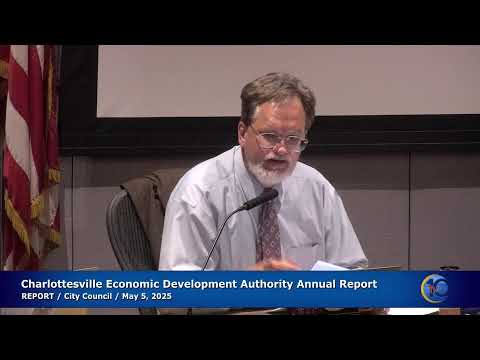
Chris Engel of the Cityoffice of economic development presented an overview of the Charlottesville Economic Development Authority (EDA) on May 5, explaining the authority's statutory powers, historical projects and current initiatives the city uses to support development.
Engel described the EDA's toolbox: conduit (tax-exempt) bond financing for qualifying manufacturing or charitable facilities, real-estate acquisition and management on the city's behalf, reimbursement agreements for public improvements (examples: the Whole Foods stub road and Water Street extension) and performance agreements that share tax increments with developers over a defined period. Engel noted roughly 64 conduit projects have used EDA authority over time, totaling about $342 million in value, and he walked the council through local examples including the Live Arts building, the downtown Pavilion and the Jefferson School rehabilitation.
Engel said some current projects are entering repayment under performance agreements (for example, Kindlewood phase one), that the EDA supports programs such as Go Startup and Go Hire, and that staff are pursuing additional grant work for Beacon Kitchen and the Envision grants in partnership with United Way. He also described a possible short-term working-capital fund to help public housing and nonprofit partners quickly acquire or preserve existing multifamily properties; details are preliminary and would target smaller, short-term loans with lower interest to preserve affordability.
Councilors asked how the city measures long-term benefits from EDA deals, whether tax and lease arrangements return sufficient value on older long-term deals (Engel used the S&P Global/Live Arts example) and how performance agreements track promised jobs. Engel said performance agreements are performance-based and that the EDA validates commitments (for tax increment and employment) before payments are released. He acknowledged limitations in tracking jobs over decades and noted the EDA is considering different structures for future agreements.
Next steps: Engel said the EDA is continuing grant and program work (Beacon Aphid application, Envision grants and a 29-corridor strategic roadmap) and will further develop the proposed short-term fund for housing preservation if council supports the concept and staff finalize program parameters.