Get Full Government Meeting Transcripts, Videos, & Alerts Forever!
Get email alerts on the Parks And Recreation topic
No spam. Unsubscribe anytime.
San Ramon council tightens athletic co‑sponsorship rules amid heated debate over cricket allocations and tier priority
Summary
City staff presented updates to the athletic facilities co-sponsorship policy—clarifying tier 1/tier 2 criteria, roster and residency rules, appeals and a code of conduct—while council members pressed staff about past cricket allocations, field capacity and funding for new pitches.
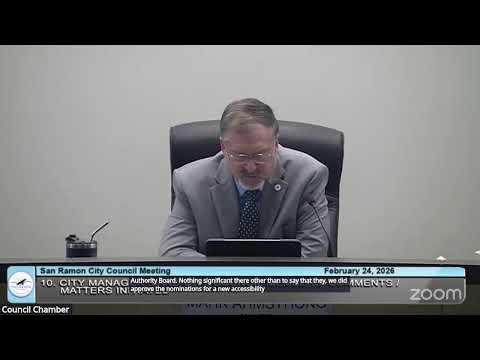
City parks staff presented a package of updates to San Ramon’s athletic facilities co-sponsorship policy on Feb. 24 and fielded detailed council questions about how the changes will affect club access to fields, with several council members focusing on recent cricket allocations.
Henry Perez Alonzo, Parks and Community Services Director, said the updates clarify the distinction between tier one and tier two co-sponsor groups, refine eligibility and residency criteria, add a formal code of conduct, strengthen communication standards and establish privacy safeguards. He told the council the policy is intended to promote equitable access to limited facilities and to support both established and emerging sports.
Key operational details include a minimum co-sponsor threshold (staff described a 100‑participant minimum with 75% resident composition for some tiers), a requirement that new co-sponsor groups be established for a period (staff discussed a three‑year establishment benchmark) and a clearer allocation flowchart for primary vs. non‑primary seasons. Henry said staff currently recognizes 14 co-sponsor groups serving about 5,700 participants, roughly 4,000 of whom are San Ramon residents.
The council’s discussion quickly turned to a specific allocation dispute on cricket pitches. Council member Rose said a prior allocation did not respect tier‑one priority among three cricket groups (SRCA/CFC youth, California Cricket Academy and an adult SRCA team), and she repeatedly requested explicit, unambiguous policy language that tier‑one groups receive priority allocations before any remaining space is given to tier two. “You need to understand that first you allocate to tier one, then only you allocate to tier two,” Rose said.
Staff responded that the policy already lists priority order and that allocations are intended to follow that order, but they agreed to tighten the language and provide clearer documentation of allocations. Henry also said an appeal process exists: an initial review and letter from the parks director, a hearing with the city manager and a further appeal to council if needed. Staff said they can facilitate stakeholder meetings but cannot compel groups to participate.
Council members asked for more data and recommended a field‑use study to quantify capacity; staff said that study is planned and will help determine whether and where additional fields could be sited. Preliminary internal analysis has identified three city‑owned sites that might accommodate cricket pitches, but staff cautioned that retrofitting fields (lighting, drainage, turf changes) could be expensive — in some cases roughly 'seven‑figure' costs — and would compete with other capital needs funded from park development or other sources. Multiple council members urged exploring public‑private partnerships, developer contributions and sponsorships as part of funding strategies.
A cricket organizer who identified himself as Hmed BH addressed the council during public comment and urged the city to pursue partnerships and flexible, lower‑cost solutions; he said his organization has invested in fields elsewhere and ran a recent free clinic that attracted 180 children (68 from San Ramon).
There was no final council vote on the policy; councilmembers asked staff and the parks commission to further clarify three areas — developer funding options, a more precise definition of what constitutes a different or enhanced service for new co-sponsors, and a clear capacity threshold — and requested a memo summarizing the parks commission’s review and the upcoming field‑use study results.