Get Full Government Meeting Transcripts, Videos, & Alerts Forever!
Get email alerts on the Student Loan Repayment topic
No spam. Unsubscribe anytime.
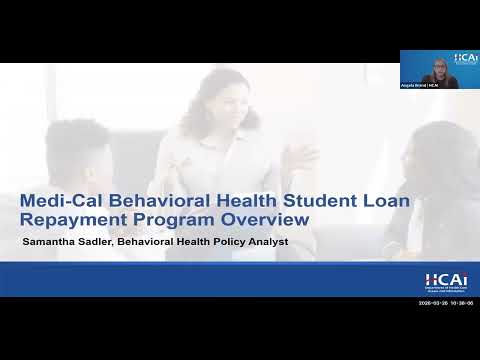
Webinar details $93.3 million California student-loan repayment program for behavioral-health workers; applications open May 1
Summary
Department of Health Care Access and Information staff outlined the Medical Behavioral Health Student Loan Repayment Program (MBH SLRP): up to $93.3 million available this cycle, individual awards up to $240,000 depending on profession, service obligations of two to four years, and an application window from May 1 to May 29, 2026.
Staff from the Department of Health Care Access and Information told viewers in a public webinar that the agency will open applications on May 1, 2026, for the Medical Behavioral Health Student Loan Repayment Program, a statewide effort to expand the behavioral-health workforce by reducing clinicians’ student debt.
"The goal of this program is to expand the availability of behavioral health professionals in the medical safety net settings by alleviating student debt and loan burdens," said Samantha Sadler, behavioral health policy analyst at the Department of Health Care Access and Information.
The department said it has up to $93.3 million for this MBH SLRP cycle and individual awards of as much as $240,000 for certain licensed prescribers. Award amounts are profession-based and will not exceed an applicant’s remaining eligible education debt at the time payment is issued. Jessica McIntyre, program manager overseeing the MBH SLRP, told attendees the 2025 grant guide (pages 15–16) contains the scoring criteria and that a 2026 grant guide with updates will be available before the application opens.
Why it matters: the MBH SLRP is part of BH Connect, a broader behavioral-health transformation that received Centers for Medicare & Medicaid Services approval in December 2024. The approval enables state investments designed to expand community-based care, improve transitions to community settings and strengthen the workforce serving people with significant behavioral-health needs.
Who is eligible and what they must do: presenters listed a broad set of eligible professions (including addiction medicine physicians, psychiatrists, nurse practitioners, physician assistants, licensed clinical psychologists, licensed clinical social workers, licensed marriage and family therapists, associate-level clinicians where applicable, registered nurses and a range of counselors and peer specialists). Service obligations depend on profession and award size: many licensed clinicians and prescribers will have four-year obligations; some non-licensed roles may have two- or three-year obligations for smaller awards. "These amounts are set by the BH special terms and conditions," Sadler said.
Service setting and hours: awards require service in an eligible medical safety-net setting, such as federally qualified health centers, community mental health centers certified by the California Department of Public Health, rural health clinics and hospitals that meet Medicaid/uninsured payer-mix thresholds (for example, hospitals with 40% or higher Medicaid/uninsured populations; rural hospitals with a 30% threshold). The department defined full-time service as a minimum of 32 hours per week providing direct client care (30 hours in school-based settings); direct care includes face-to-face care, telehealth and first-line supervision.
Employer verification and reporting: applicants must provide a point of contact for each employer so HAI can send an Employer Verification Form (EVF). Employers have an initial five days to complete the EVF for application review; awarded grantees must submit EVFs every six months to demonstrate compliance.
Timing and payment: the application window opens May 1, 2026, at 3 p.m. PDT and closes May 29, 2026, at 3 p.m. Anticipated award notices are estimated for September 2026, with proposed grant agreements starting in October 2026. Payment is expected during the first year of the service obligation; presenters noted prior-cycle payments averaged about 90% of eligible loan amounts as an operational precaution against overlap between award and loan-account activity.
Questions and common clarifications addressed: presenters confirmed that consolidated and private educational loans may be eligible if they clearly document original loans and degrees; loans in forbearance are acceptable if not in default; residency or fellowship trainees generally must hold an unrestricted license to apply; applicants with an ongoing service obligation must complete it before seeking additional HAI awards; and applicants who apply within the posted window are considered equally rather than on a first-come basis.
Where to find details: presenters repeatedly directed applicants to the program web page, the grant guide (the 2026 edition will include updates) and a shortage-designation lookup tool. For specific application questions, staff asked applicants to email mbhslrp@hai.ca.gov. A recorded copy of the webinar and a slide deck will be posted within 7–10 business days.
The webinar closed with agency staff thanking attendees and encouraging dissemination of the program flyer and subscription to the department’s mailing lists for future updates.