Get Full Government Meeting Transcripts, Videos, & Alerts Forever!
Get email alerts on the Land Use Development topic
No spam. Unsubscribe anytime.
Destin council finds Legendary Companies’ Harborwalk Phase 2 not in compliance, directs further review
Summary
After a quasi‑judicial hearing and public testimony, the City of Destin Council voted 5–0 with one abstention on April 13, 2026, to find the Harborwalk Village Phase 2 proposal not in compliance with development order DO10‑02, citing height, setback, access and parking concerns; the applicant may seek a major deviation or return for additional review.
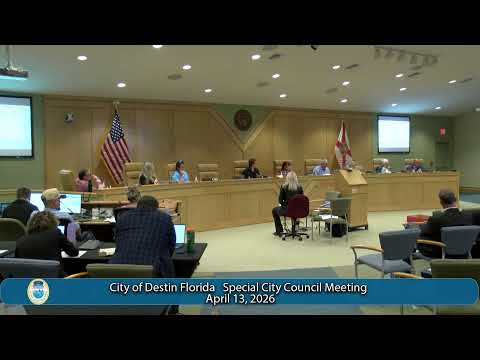
The City of Destin City Council voted April 13 to find that Legendary Companies’ Harborwalk Village Phase 2 proposal is not in compliance with the previously approved development order (DO10‑02), citing multiple technical departures identified in the staff report.
Community Development Director Miss Deer told the council that staff’s review found several issues bearing on the legal standard for a major deviation: the applicant’s plans show a maximum building height of about 106.75 feet (the approved limit in DO10‑02 is 100 feet and nine stories), portions of the project fail to meet a 15‑foot frontage setback, the proposed northeast access differs from the right‑out-only access in the original order, and the new plans propose parking in excess of limits in the multimodal transportation district ordinance (08‑14‑LC). Those findings were entered as part of the staff report and supporting exhibits.
“The decision tonight must be based on competent, substantial evidence submitted at the hearing,” Miss Deer said, and she identified development order 04‑13 (condition 19) as the criterion that defines what constitutes a major deviation.
Legendary’s attorneys and consultants urged a different view. Dana Matthews, counsel for Legendary, said the company spent nearly $1.9 million preparing updated plans and argued the project is substantially consistent with the 2009 entitlements. “We listened to what you had to say,” Matthews said. The applicant’s team included owner Peter Boss and consultants who argued the three small tower elements are architectural embellishments that should not be counted as whole stories, and that the low‑grade walkout level should be treated as a basement under the code.
Consultant Steven Tatum urged the council to allow staff to resolve technical details at the TRC (technical review committee) stage if the council made a substantial‑compliance finding. “These are things that can be worked out at staff level,” Tatum said, listing adjustments to tower treatment, setback details and garbage enclosures as items he believed could be resolved without returning to council.
On parking, the record contained competing analyses. A member of the public, John Stevens, said applying advertised passenger capacities for charter and tiki‑boat operators increases the project’s parking requirement (he estimated 560.25 spaces required versus 498.6 shown in materials, a difference of about 61 spaces). Legendary’s consultant said the city’s hired consultant, Inspire Placemaking Collective, reviewed the project under three lenses and found a parking surplus under each method: 587 surplus spaces under the project’s vested baseline chart, 144 surplus under the current land development code, and 252 surplus using the Urban Land Institute shared‑parking model. The disagreement over which standard governs was a focus of council questioning.
Legendary also offered an HOS Institute economic analysis submitted as an applicant exhibit. Greg Darden, testifying for Legendary, summarized HOS’s findings: Harborwalk as it sits generated roughly $282 million in overall economic impact (about $141 million regional), supported more than 1,700 jobs (average salary near $48,000) and produced about $2.8 million in local taxes; the proposed phase 2 alone was projected to add about $228 million in regional impact, roughly 2,100 jobs (average salary about $73,000) and roughly $4.2 million in local taxes; combined impacts were presented as roughly $370 million in regional activity and nearly $7 million in local/regional tax impacts.
Public testimony included safety and character concerns and praise for the Harborwalk. Alan Osborne, a waterfront resident, said the harbor “is a freaking zoo” during busy periods and urged the council to guard safety and existing character. By contrast, resident Vandy Bella said she benefited from the Harborwalk and urged the council to consider public‑benefit partnerships and connectivity improvements, including pedestrian connections under U.S. 98.
Council members pressed both sides for more precise, engineered documentation. Several members said that while some items might be fixable administratively, the staff report raised enough issues — height/story count, setbacks, unresolved phase 2B details, and the multimodal parking limit — that the council could not confidently find full compliance at this time. One council member said staff had identified several issues only in the last week’s report, making it difficult to fully vet every change without further review.
A council member moved to find the applicant not in compliance with DO10‑02 for the reasons set forth in the staff report and to allow the applicant to pursue the options enumerated in Exhibit A (apply for a major deviation or return for supplemental compliance review). Councilwoman Traml seconded the motion. The council recorded a 5–0 vote in favor with one abstention; Councilwoman Abear recused herself from voting because of a spouse’s employment with Legendary.
Under the motion, the applicant may either apply for a major deviation to the development order or work with staff to address the flagged technical non‑conformities and then return to council for an additional compliance determination. If the council had instead found the plans in compliance, staff emphasized that the application would still require full TRC review with fully engineered plans before any permits were issued; staff cannot authorize non‑compliant elements through TRC alone.
The council’s action concludes the April 13 hearing; the meeting was then adjourned. The applicant may now choose which procedural path to pursue next.
What’s next: Legendary must decide whether to revise the plans and pursue a minor amendment route after resolving the listed issues with staff or to apply formally for a major deviation to the previously approved development order. Either route will require additional technical submittals and, if disputes remain, possible further council review.