Get Full Government Meeting Transcripts, Videos, & Alerts Forever!
Get email alerts on the Transit Policy topic
No spam. Unsubscribe anytime.
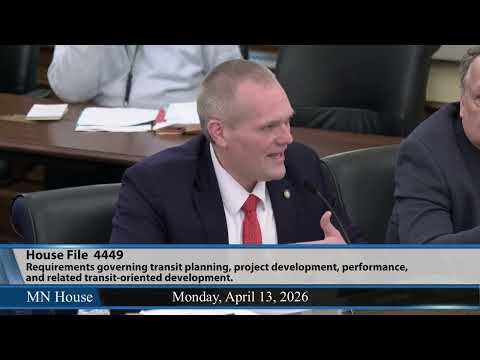
Rep. Jones pushes performance targets, coordination and TOD authority in Twin Cities transit bill; committee lays measure over
Summary
At a House Transportation Committee hearing on House File 4449, Rep. Jones proposed numeric transit performance goals, earlier coordination of road and transit construction, and limited authority for the Met Council to acquire property for transit‑oriented development. Members pressed the author on safety carve-outs, local control and fiscal impacts; roll calls on two amendments failed and the bill was laid over for further work.
Representative Jessica Jones presented House File 4449 as a package to make the Twin Cities transit system more reliable, efficient and oriented to development, opening the Transportation Committee hearing by asking, “Do we want a growing Twin Cities metro that can compete with peers and a place for businesses and residents [to] thrive?” Representative Jones framed the bill around three problems: an absence of numeric goals for the region’s transit network, poor coordination between road construction and transit projects, and limited tools to support transit‑oriented development (TOD).
Jones said the measure would establish concrete performance targets — pairing ridership with frequency, tracking operating cost per passenger and setting speed and reliability benchmarks — to drive investment toward corridors that can generate the greatest transit utility. She told the committee a central goal is “to build the confidence and cost effectiveness in the transit system and to grow it to reach the needs of more people.”
On coordination, Jones used Lyndale Avenue as an example where a county‑led reconstruction and a planned bus rapid transit project could lead to redundant work if projects are not aligned. The bill would require earlier corridor planning and create a Transit Investment Framework incorporated into the regional development guide so substantial street reconstructions can add transit elements at the time of construction rather than tearing up the same corridor years later.
To support ridership growth near transit stops, the bill also would give Metro Transit/Met Council additional flexibility to acquire and hold property for development that supports higher ridership. Jones said the council could issue requests for proposals to private developers or develop parcels directly to accelerate transit‑oriented development.
Two committee amendments drew sustained attention. Representative Olson moved an A2 amendment to exempt highway projects that primarily address documented safety issues from the bill’s coordination requirements, arguing that safety repairs should not be made substantially more costly by added transit mandates. After debate, the committee took a roll call; the chair announced a recorded tie of 8 ayes and 8 nays and stated, “the motion does not prevail.”
A second amendment, A3, sought to allow local cities to adopt a resolution or local referendum to opt out of the bill’s requirements, which a sponsor framed as protecting local control and giving voters a direct voice. A roll call was held; the clerk recorded ayes and the transcript indicates the chair announced the motion did not prevail. The transcript includes garbled roll‑call lines and duplicated text; the committee nonetheless proceeded to take testimony.
Scott County Commissioner Jodi Brennan urged caution, saying the bill as written could redirect local sales‑tax revenue dedicated to county roads to the Metropolitan Council without meaningful county influence or a formal appeal mechanism; Brennan asked for a defined geographic scope, equitable opt‑out language for counties, and a clear appeals process.
Hennepin County Commissioner Mary Green praised the bill’s goals, arguing that robust, integrated transit is critical for household budgets and economic development. Green told the committee that “more than 35% of development in the Twin Cities region has occurred in high‑frequency transit corridors since 2005,” and highlighted the role of transit investments in leveraging federal funds and creating jobs.
MJ Carpio, executive director of Move Minnesota, testified in support of performance measures and an investment framework, saying clearer targets will help ensure public funds are used to expand fast, frequent, reliable service and encourage ridership and transit‑oriented development.
Committee members pressed the author on several points: how safety projects would be treated, whether long cross‑jurisdictional routes would be penalized if one locality failed to align with corridor plans, the potential for the bill’s population‑density metrics to concentrate funding in core cities at the expense of suburban areas, and how Met Council land acquisition and development would be managed and funded. Jones repeatedly said she is open to continued conversations with counties, cities and stakeholders and emphasized that the bill is intended to target major reconstruction projects rather than minor safety fixes.
The committee did not pass the bill; the chair announced House File 4449 is laid over for further work. The hearing produced recorded roll‑call votes on two amendments (A2 and A3), sustained testimony from county officials and advocates, and commitments from the author to continue refining the measure with local partners.