Get Full Government Meeting Transcripts, Videos, & Alerts Forever!
Get email alerts on the Legislative Recap topic
No spam. Unsubscribe anytime.
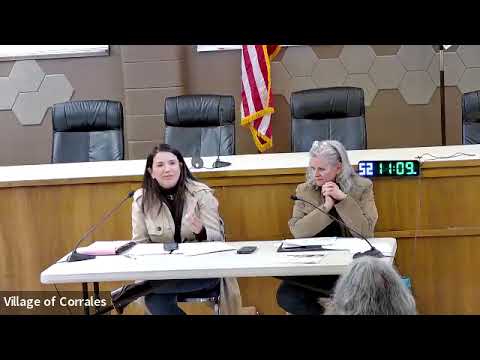
Sen. Cindy Nava and Rep. Kathleen Kates recap 2026 session: police applicant eligibility, behavioral-health funds and water investments
Summary
At a Corrales Village town hall, Sen. Cindy Nava and Rep. Kathleen Kates described this year's legislative accomplishments: a law allowing lawful permanent residents and DACA recipients to apply for police positions, a three-bill behavioral-health package including a $140 million appropriation, and multiple water-protection bills and local capital projects.
Sen. Cindy Nava and Rep. Kathleen Kates told residents at a Corrales Village town hall that this year's legislature delivered several laws and appropriations they said will affect public safety, behavioral health and local water projects.
Nava, the first-term senator for Senate District 9, said one of her signature measures, Senate Bill 364, removes U.S. citizenship as the exclusive requirement for state and local police applicants and opens eligibility to legal permanent residents and DACA recipients who are lawfully present. "Starting in June, folks will be able to apply who are non-citizens but have legal permanent residency or DACA status," Nava said, noting the change aims to widen recruiting pools for rural departments.
The lawmaker described SB 364 as both a public-safety and workforce-development measure. Nava said the bill passed both chambers with bipartisan support, was signed by the governor on April 7 and will take effect in June. She credited cross-party sponsors, including Speaker Martinez and Senators Craig Brandt, Cervantes and Padilla, for advancing the proposal through committee and floor votes.
Representative Kathleen Kates summarized capital-outlay and district-specific appropriations she said she helped secure for Corrales Village: $100,000 for Corrales Elementary, funding for fire-suppression and construction projects, police equipment and a rescue ambulance, and turn-lane and flood-control work tied to local drainage. "We try to fully fund the fire and police requests in Corrales," Kates said, adding that close coordination between senator and representative is essential because the two offices now represent the same village after 2023 redistricting.
Both legislators highlighted a three-bill behavioral-health package the Senate advanced this session. Nava said the package included SB 1 (a behavioral-health trust fund), SB 2 (a roughly $140 million regional-services appropriation) and SB 3 (creation of a behavioral-health executive committee to coordinate regional services and identify local gaps). "These bills are not an absolute fix," Nava said, "but they are a strong, collaborative starting point to expand services and stabilize care across the state."
Water policy was another central topic. Kates and Nava pointed to multiple water bills signed this session and described work on the New Mexico Tech 50-year water plan referenced during their remarks. Kates, vice chair of state water committees, said the Legislature advanced appropriations through the New Mexico Financial Authority and other mechanisms to support drinking-water, watershed and septic projects while restoring some state-level oversight after a federal regulatory retreat.
What they did not claim: neither legislator said the new laws eliminate all local water risks or that funding fully resolves long-term shortages. Both stressed continued work, public outreach and follow-up: Nava said staff will share information about application processes and local resources for residents who may benefit, and Kates asked constituents to keep engaged on capital-outlay prioritization.
The town hall moved to audience questions after the presentation; residents pressed the lawmakers on production-versus-consumption trade-offs for oil and gas, on groundwater protections, and on how state policy balances economic revenue with long-term water sustainability. Nava and Kates described stepped-up leasing-fee policies, incentives to reuse produced water and enforcement measures aimed at small operators that fail to cap wells properly, but said outright halting of production is legally and practically complex.
The lawmakers said they will follow up with detailed materials and community briefings. The most immediate next steps residents were given: materials about SB 364 application guidance (when available) and contacts for capital-outlay project status. The town hall concluded with a broader call from both legislators for continued constituent engagement on water, health care and public-safety priorities.
Ending: Nava and Kates encouraged residents to raise questions with their offices and sign up for updates; both said they plan to return with follow-up information on specific programs and funding timelines.