Get Full Government Meeting Transcripts, Videos, & Alerts Forever!
Get email alerts on the Artificial Intelligence topic
No spam. Unsubscribe anytime.
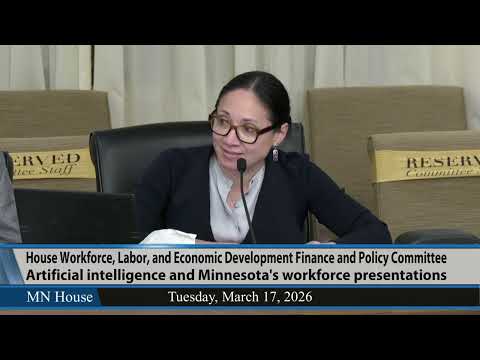
House committee hears University and labor groups on AI, workforce impacts and proposed worker-protection bills
Summary
University of Minnesota researchers outlined a new AI Hub and its statewide strategy; labor and tech-equity groups warned of displacement and surveillance risks and urged worker protections. Representative Godfrey previewed three companion bills addressing just transition, automated decision systems, and electronic monitoring.
The House Workforce, Labor and Economic Development Finance and Policy Committee held an informational hearing focused on artificial intelligence and the workforce, hearing presentations from university researchers and policy groups and a preview of three proposed bills aimed at protecting workers from harmful AI-driven practices.
Presenters from the University of Minnesota described a newly launched AI Hub, the university's AI strategic roadmap and research strengths in high-performance computing and interdisciplinary AI. University presenters said the hub will focus on education and upskilling, research infrastructure and outreach, with a stated commitment to responsible and ethical AI, human oversight, bias mitigation and public engagement. The university noted existing partnerships and convenings with industry, including a recent delegation meeting with representatives from NVIDIA and other companies.
Labor-focused presenters warned of significant workforce exposure to generative AI. A Northstar Policy Action researcher said the study with a collaborator at the University of St. Thomas estimates roughly one-third of Minnesota workers (about 800,000 people) have "high" exposure to generative AI (defined in the testimony as generative AI doing 50% or more of a worker's tasks) and that Minnesota ranks high among Midwestern states in vulnerability. The presenter recommended three priorities: limits on intrusive digital surveillance, prohibitions on algorithmic final decision-making (including hiring), and transition supports such as notice and retraining.
A Tech Equity representative joining by Zoom urged a policy framework that centers workers, including transparency, worker participation in deployment decisions, limits on surveillance, and training investments to ensure benefits are broadly shared. Melissa Hazing, legislative director for the Minnesota AFL-CIO, spoke in support and urged the committee to add impact-assessment requirements, independent third-party review, and anti-retaliation protections for workers who raise concerns.
Representative Godfrey previewed three informational bills that mirror the testimony: a just-transition notice and retraining proposal (identified in the packet as HF 4369 in the transcript), an automated decision systems bill requiring pre- and post-deployment notice, appeal rights and prohibitions on certain uses, and an electronic monitoring bill creating notice and appeal rights and limiting some surveillance uses. Godfrey and other members emphasized they will continue drafting and soliciting stakeholder input.
Committee members from both parties expressed interest in pursuing rules that protect workers while preserving Minnesota's competitiveness; several members urged careful drafting because AI capabilities are rapidly evolving. The committee did not take votes on the previewed bills at this meeting but signaled bipartisan interest in further work.
Direct quotes in the record were sometimes transcribed with garbled proper names; where the transcript contained unclear spellings, this article attributes content to role or affiliation to avoid misidentification.