Get Full Government Meeting Transcripts, Videos, & Alerts Forever!
Get email alerts on the Children Museum topic
No spam. Unsubscribe anytime.
Peabody council hears museum update as staff, access programs and funding needs draw scrutiny
Summary
The Northshore Children’s Museum told the Committee of the Whole it has stabilized after a strong 2023 launch but still relies on city support, faces gaps in visitor data, and is pursuing exhibit upgrades, expanded outreach and staff restructuring; councilors pressed for plans to reduce municipal subsidy and boost fundraising.
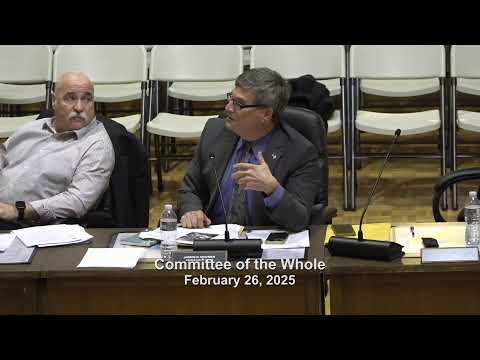
The Peabody City Council Committee of the Whole received an update on the Northshore Children’s Museum on an agenda item opened after an executive session.
John Coowell, identified at the podium as director of the Northshore Children’s Museum, told the council the museum began as a pop‑up in 2019, opened in October 2022 and now offers 14 hands‑on exhibits aimed at children ages 1–7. He said the Friends of the Northshore Children’s Museum obtained 501(c)(3) status in April 2024 and now handles most grant applications and individual fundraising for exhibits and reduced‑admission programs.
The museum is pursuing exhibit upgrades and new elements for 2026, including a STEM car racetrack for Duplo car building and testing, sensory‑friendly fiber‑optic lighting, a large geoboard and a sound machine tied to a nature room mural. Coowell described a 2025 program of custom, higher‑durability interactives intended to raise the overall quality and long‑term value of the museum’s offerings.
Coowell presented attendance and revenue trends showing a strong first full year in 2023 with more than 33,000 visitors, followed by a moderation in 2024–25. He said recorded visitor origin data are incomplete because the museum lacks zip‑code data for about 32,000 past transactions; using available data, Peabody residents account for roughly 57–89 percent of current tracked transactions, with Peabody (11,000), Salem (6,600), Beverly (4,500) and Danvers (3,400) among the top origin towns.
On revenues, Coowell said the museum’s business model centers on earned income (admission, memberships and parties) supplemented by contributions and grants. He reported that the museum applied for roughly $271,000 in grants in 2024–25 and received about $30,000, and cited a $25,000 grant used for an exhibit paid in its last installment. He also described how some reduced‑price and free admissions—designed to expand access—lower per‑ticket receipts: the museum’s reduced admission program charges $3 per person versus a regular $12 ticket.
Coowell highlighted access programs that the council and staff consider central to the museum’s mission: a reduced‑admission program that had served nearly 11,000 visitors (which he estimated saved families about $100,000), 2,000 Peabody residents visiting on free days, a library‑pass network covering 30 towns, and 137 field trips in 2025 that brought more than 5,000 students from 15 towns. He said the museum caps field trip fees at $500 and makes scholarships available for schools that need financial help; those scholarships and many free days are funded by the Friends and other community supporters, not by the city.
Councilors used the question‑and‑answer period to press several operational and fiscal issues. Council Lov and others asked about staff numbers and whether the museum is approaching a break‑even point; Coowell said the museum currently has two full‑time staff, a full‑time community engagement manager and seven part‑time visitor experience associates, and that the organization reduced a prior third full‑time position to save health‑insurance costs while hiring a part‑time marketing specialist.
Councilor Peach asked whether first‑grade visits from Peabody elementary schools are uniformly funded; Coowell said the museum offers Peabody schools a reduced field‑trip rate (about $6 per student versus $8 for non‑Peabody groups) and that funding arrangements (PTO, district or other support) vary; he offered to investigate and report back. Councilor Corvo expressed concern that shifting fundraising and operational responsibilities entirely onto the Friends 501(c)(3) could transfer too much of the museum’s cost burden away from the city; Coowell and the mayor said there is no fixed date to end municipal support and that the intent has been gradual reduction of city subsidy as earned and philanthropic income grow.
Several councilors suggested hiring or budgeting for a dedicated grant‑writer or fund‑development role to improve the Friends’ and museum’s capacity to capture competitive grants; Councilor Welton recommended revenue‑generating staffing investments such as a development hire.
The museum said it is exploring how to use its outreach van to deliver off‑site field trips (to capture field‑trip revenue when schools cannot bring students to downtown) but noted staffing limitations for off‑site programming until a more consistent educator or program staff member is hired.
The presentation also raised local economic ties: Coowell reported a 2025 survey of more than 150 visitors showing most use paid parking and that roughly 30 percent visit other downtown Peabody businesses before or after museum visits; he said museum patrons’ parking behavior appears to contribute to downtown meter revenue, and councilors requested more granular parking‑lot utilization data once the city’s parking system upgrade permits easier reporting.
The meeting record indicates the Committee moved to receive the presentation and later adjourned; formal executive session and return votes were taken earlier in the evening (roll‑call votes recorded 11–0). The presenter said budget detail and a proposed FY budget will be returned to council in May–June.
Questions the council asked that remain to be resolved on the record include a precise town‑by‑town breakdown of reduced‑admission program usage, confirmation of who pays for first‑grade field‑trip bus costs across Peabody schools, and a timetable or plan for reducing city subsidy. Coowell and the mayor offered to follow up with those details at the museum’s next briefing to the council.