Get Full Government Meeting Transcripts, Videos, & Alerts Forever!
Get email alerts on the Transportation Infrastructure Overview topic
No spam. Unsubscribe anytime.
Virginia transportation secretary reviews major projects, DMV overhaul and warns of maintenance gap
Summary
Secretary of Transportation Shep Miller briefed the House Transportation Committee on major projects including the HRBT expansion, I‑64 gap, Long Bridge, port dredging and DMV modernization, and cautioned that construction-heavy funding streams leave maintenance shortfalls that must be addressed.
Secretary of Transportation Shep Miller told the House Transportation Committee that the Commonwealth has made “great progress” on a string of large transportation projects but faces growing maintenance obligations as new capital work comes online.
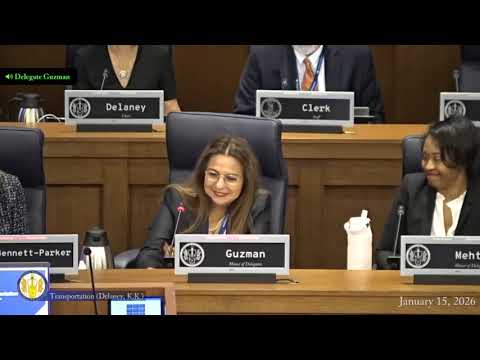
Miller, speaking at an administrative committee meeting called by Chair Carrie Delaney, outlined accomplishments during his four-year tenure and sketched priorities for the transition. He cited the Hampton Roads Bridge‑Tunnel expansion, the I‑64 gap project, the I‑81 corridor program, upgrades at Port Virginia and the Long Bridge rail project among the headline items.
Why it matters: the projects Miller described involve recurring maintenance costs and multiyear timelines, and several require cooperation or funding outside the Commonwealth, meaning the committee will need to weigh capital investment against long‑term upkeep.
Miller highlighted schedules and dollar figures for several projects. He said the I‑64 gap project is a roughly $756 million effort to close a 20–29 mile gap, with segments A and C expected to be finished in 2027 and segment B in 2029. On the Hampton Roads Bridge‑Tunnel he noted the twin tunnel‑boring milestones and said contractors are targeting completion in 2027, with the tunnel boring described as the “critical path.” He summarized the Long Bridge two‑track railroad project as a $2.3 billion effort, helped by a $729 million FRA grant, with an expected completion in 2030.
On ports, Miller said a $450 million dredging program to deepen the harbor to 55 feet will be complete this year, allowing larger vessels to call and increasing throughput. He described a $650 million North Terminal expansion at Norfolk International Terminals due in 2027 and other rail and lease renegotiations intended to reduce costs and increase certainty for port operations.
Miller also reviewed transportation funding and performance metrics. He said the I‑81 corridor improvement program’s original $3.9 billion portfolio has been augmented by roughly $500 million in additional funding, and he reported that VDOT on‑time project delivery rose from 77% to 93% between 2022 and 2025 while on‑budget performance held at about 95%.
On DMV modernization, Miller described an employee‑led transformation of 354 initiatives, a mainframe‑to‑cloud migration he said is about 28% complete, and personnel investments of roughly $15 million that he said have cut turnover by about 50%. He cited a drop in average in‑office wait time from a pre‑COVID 37 minutes to 14.3 minutes and noted that, in December, staff recorded an average wait of 4.2 minutes. “Listen, they’re not perfect. None of us are, but the change has been fundamentally dramatic,” Miller said.
Miller described technology pilots including an automated road test that uses an iPhone mounted in a test vehicle to record and score a road test, a rollout planned by 2027, and a mobile ID accepted at airports and by some law enforcement agencies. He also outlined investments in aviation workforce training, advanced air mobility pilots, and expansion of Virginia Space facilities at Wallops Island.
Committee members praised the work and asked for follow-ups. Delegate Austin thanked Miller and singled out growing rail ridership and DMV director Gerald Lackey for praise. Delegate Reed asked about coordination with Maryland on projects that cross state lines, including the American Legion Bridge; Miller said Maryland must show political will and identify funding before a coordinated project can proceed. Delegate Watts asked for a separate turnover accounting for Northern Virginia DMV offices; Miller agreed to provide that breakdown and said the committee staff would receive requested data.
Miller closed by warning that many regional authorities dedicate nearly all revenue to construction, which creates a maintenance funding gap for new assets. He said certain new assets—new HRBT tunnels, for example—will add recurring maintenance costs (he estimated roughly $40 million a year to maintain the new tunnels alone) and urged the committee to consider how maintenance will be sustained as capital projects come online.
The committee adjourned after a short question-and-answer period. A motion to adjourn carried by voice vote.