Get Full Government Meeting Transcripts, Videos, & Alerts Forever!
Get email alerts on the Higher Education Tuition topic
No spam. Unsubscribe anytime.
Committee lays over bill to allow in‑state tuition for students whose families moved to Minnesota for employment
Summary
The House Higher Education Committee heard HF3432, which would let individuals who moved to Minnesota for full‑time jobs qualify for resident tuition beginning fall 2027; authors adopted verification amendments and limited the change to tuition (not state financial aid). The committee laid the bill over pending a fiscal note.
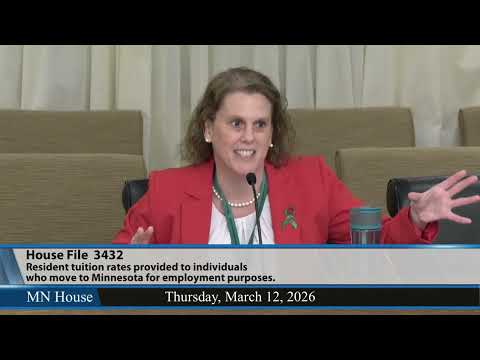
Representative Rayner presented House File 3432 to the House Higher Education, Finance and Policy Committee, saying the proposal grew out of a constituent case in which a family that relocated to Minnesota for work could not access resident tuition for their child.
The bill would allow individuals who accepted full‑time employment in Minnesota before moving and before applying for admission to a public postsecondary institution to qualify for resident tuition rates, with an effective term beginning fall 2027. Rayner told the committee she had consulted both Minnesota State and the University of Minnesota; both institutions asked for the delayed effective date and asked the bill to be explicit that the new language sets a minimum eligibility threshold because campuses sometimes make exceptions for other reasons.
Members adopted two author’s amendments. Amendment A2 clarifies that qualifying for resident tuition under the bill does not automatically make a student eligible for state financial aid programs; Mr. Hopkins explained the change inserts a new section limiting the scope so that the new tuition language will not expand the definition used for state grant eligibility. Amendment A1 requires documentation to verify the employment used to establish eligibility; members discussed acceptable proofs such as pay stubs or certified job offer letters and the author said she would work with institutions on workable language.
Committee members questioned the bill’s scope and fiscal impact. Supporters, including Rayner, said the measure is a modest way to encourage families to relocate for employment and thereby help address a long‑term labor shortage. Opponents raised concerns about potential costs to Minnesota taxpayers and the state grant program, the possibility of short‑term or low‑wage hires qualifying without real ties to Minnesota, and the absence of an estimate for how many students would be affected. Multiple members noted a fiscal note had not yet been received.
After discussion the committee voted to lay HF3432 over for possible inclusion so staff can complete a fiscal analysis and the author can refine definitions and verification procedures. The committee did not vote on final adoption of the bill at this meeting.
Next steps: the bill is laid over pending a fiscal note and further technical refinement; the committee signaled willingness to revisit documentation standards and related questions about private colleges and cross‑state reciprocity.