Get Full Government Meeting Transcripts, Videos, & Alerts Forever!
Get email alerts on the Voter Information Guide topic
No spam. Unsubscribe anytime.
Committee advances bill to create Minnesota voter information guide amid debate over cost, scope and review
Summary
Senate File 4135 would require the Secretary of State to produce a mailed and online voter information guide; the committee adopted technical and transparency amendments, discussed distribution models, language/accessibility, candidate statement length and administrative review, and recommended the bill to pass 7–4.
The Senate Elections Committee advanced Senate File 4135, a bill authorizing a Minnesota voter information guide to be published by the Office of the Secretary of State, after adopting authors and technical amendments and extensive committee discussion about scope, distribution, cost and content.
Sen. Cwodzinski, the bill’s author, said the guide aims to replace lost local newspaper coverage by providing a nonpartisan, mailed and online product with candidate statements, basic voting information, and explanations of constitutional amendments. “Democracy dies in darkness,” she said, arguing an official guide would offer neutral information to voters and support civic engagement.
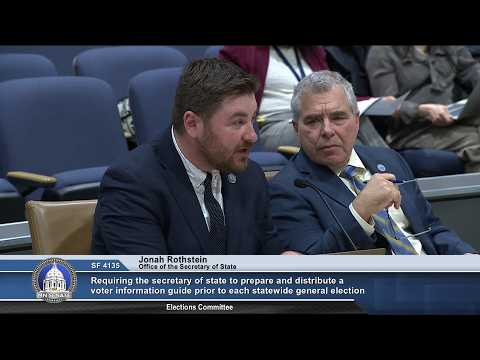
Jonah Rothstein of the Secretary of State’s Office presented research showing 32 states publish some form of voter guide; states differ on distribution models (statewide, regional, or by judicial district). The office proposed a printed-and-mailed guide plus an online companion PDF and noted the draft excludes local offices (counties, cities, school boards) pending future expansion. Rothstein said distribution and exact formats would be resolved in rulemaking after further cost analysis.
Lilly Sassy, director of the We Choose Us coalition, testified in support, saying a mailed and online guide could increase accessibility and combat misinformation by centralizing neutral information in multiple languages and formats.
Members pressed the author and Secretary of State staff on several issues: the fiscal note (Andrew Erickson summarized an estimated initial cost around $2.8 million including rulemaking, temporary hires and printing/shipping), whether candidate statements should be printed in mailed copies or limited to online, whether 100 words is sufficient for candidate statements and whether pictures should be included, how to handle distribution to households with multiple registered voters, and safeguards for nonpartisan editing and administrative review. The draft allows the Secretary of State to reject or edit submitted candidate statements that are obscene or otherwise prohibited and to appeal to the Minnesota Court of Administrative Hearings; several senators asked for clearer guardrails to ensure the process is perceived as nonpartisan.
On amendments: the committee adopted the A3 authors amendment (technical reorganization), rejected an A5 amendment (which would have treated returned household mailings as a tool for voter‑roll maintenance) by roll call (5 yeas, 6 nays), and adopted an A4 amendment to show party breakdowns for constitutional amendment votes in the guide. The committee then recommended SF4135 as amended to pass and be referred to the State and Local Government Committee by a roll call of seven yeas and four nays.
What happens next: State and Local Government Committee will consider rulemaking issues and implementation details such as distribution model, languages, accessibility formats, and whether printed guides should include candidate statements or instead reference an expanded online companion.