Get Full Government Meeting Transcripts, Videos, & Alerts Forever!
Get email alerts on the Labor Workplace Conditions topic
No spam. Unsubscribe anytime.
Senate Labor Committee hears bill to require seating where work permits
Summary
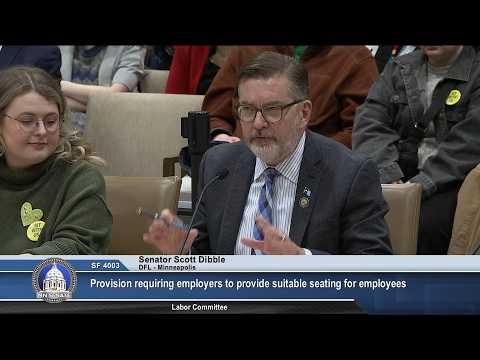
The Senate Labor Committee heard testimony on Senate File 4003, a bill that would require employers to provide suitable seating and allow workers to sit when the nature of the work reasonably permits; supporters cited health and dignity, while business groups warned of vague terms and compliance costs.
Senate File 4003, introduced to the Senate Labor Committee by Senator Scott Dibble, would require employers to provide suitable seating placed reasonably close to the work area and permit employees to use those seats when the nature of the work reasonably permits. The sponsor said enforcement would be handled by the Minnesota Department of Labor and Industry and that violations could carry a $250 penalty.
Supporters, including Michelle Maser, former president of the Walker worker union, described the bill as a practical correction to recent employer actions at the Walker Art Center that removed stools and in some cases required doctor’s notes for seating. Maser said the union gathered petitions, letters and patron support, and cited research linking prolonged standing to back pain, fatigue and other health problems. A union representative from the Food and Commercial Workers also testified that seating can reduce injuries and improve productivity at checkout lines.
Business groups raised implementation concerns. Lauren Shot Horst of the Minnesota Chamber of Commerce and a state director for the National Federation of Independent Business warned that terms such as “when the nature of the work reasonably permits,” “reasonable proximity,” and “per violation” are open to subjective interpretation and could create litigation risk and burdens for small employers operating in cramped spaces. They asked the committee to refine the language and seek more clarity about enforcement and fiscal impact.
Committee members debated whether seating is best handled by collective bargaining or by statute. Some senators said the issue can and should be negotiated at the bargaining table; others pointed to the Walker example and said statutory baseline protections are warranted. The sponsor said he will work with stakeholders to refine definitions and that the committee received technical input from the Department of Labor and Industry.
Following testimony and deliberation, the committee laid Senate File 4003, as amended, over for further consideration.
The next procedural step is committee follow-up and drafting clarifications; the sponsor asked to continue conversations with employers, labor groups and the Department of Labor and Industry.