Get Full Government Meeting Transcripts, Videos, & Alerts Forever!
Get email alerts on the Gop Affordability Agenda topic
No spam. Unsubscribe anytime.
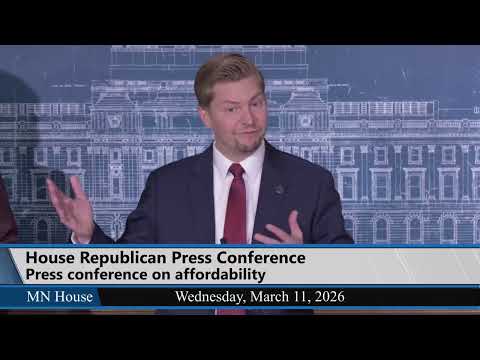
House Republicans outline affordability agenda, press Democrats to move bills
Summary
House GOP leaders Speaker Lisa DeMuth and Leader Harry Niska on a public briefing laid out proposals to lower costs — including eliminating taxes on tips and overtime, repealing the retail delivery fee and creating a property-tax commission — and urged House Democrats to stop delaying bills in committee so measures can reach the floor before May deadlines.
House Republican leaders on a public briefing framed an "affordability" agenda that centers on tax cuts, rolling back recent fees and limiting new mandates, and urged Democrats to advance bills out of committee so they can reach the House floor and the governor.
"We had an 18 billion dollars surplus that was completely spent," Speaker Lisa DeMuth said, arguing that "our taxes here in Minnesota were raised another 10 billion dollars," and that "government spending grew 40%." She said those choices had made the state "a more expensive place to live." (Remarks by Speaker Lisa DeMuth.)
The Republican priorities DeMuth and House GOP Leader Harry Niska described include eliminating state taxes on tips and overtime, repealing the 2023 retail delivery fee, ending a tax on Social Security, lowering vehicle registration fees, making the reinsurance program permanent, expanding access to direct primary care, allowing schools and local governments to opt out of certain mandates, and creating a property tax commission to pursue reductions.
"House Republicans' goal is simple: make Minnesota affordable so hard work pays off," DeMuth said, and she told reporters the caucus plans to pursue individual bills rather than a large omnibus package. "You're not going to see that come through the House chamber this year at all. What you will see is individual proposals."
On legislative process, DeMuth accused House Democrats of delaying measures in committee and using items as late-session bargaining chips. "If the bills are going to make it to rules, we have to get them out of committee," she said, urging Democrats to either move bills forward or vote them down on the House floor rather than stall them in committee.
Asked about the fiscal impact of some tax preferences, a questioner referenced figures cited in the briefing, saying the tip-and-overtime exemptions were discussed in the range of "over 26 million dollars" and that, combined with other items, figures could approach "close to 500 million." DeMuth responded that the caucus would "definitely look at all that" and that the state had a temporary cushion (she referenced about $3 billion) that could allow some conformity or targeted relief if lawmakers agree.
Leaders also flagged systems modernization — upgrades to county and state benefit-administration IT — as a possible, broadly supported investment that could reduce fraud and administrative costs. DeMuth said Republicans have sought county system investments in past negotiations and are optimistic about finding agreement.
No formal motions, votes or bills were taken or enacted during the briefing. The leaders emphasized that the next procedural steps are committee consideration, placement on the General Register, rules calendaring and floor votes before statutory deadlines in May.
The briefing closed after a final question about whether a proposal from Representative Mary Franzen on a beverage/container tax would be considered; DeMuth replied that it was not a priority at this time and ended the session.