Get Full Government Meeting Transcripts, Videos, & Alerts Forever!
Get email alerts on the Library E Book Licensing topic
No spam. Unsubscribe anytime.
Minnesota committee refers bill targeting library e-book license terms after split testimony
Summary
The House Education Policy Committee referred HF 36,98 after competing testimony: library advocates said publishers’ licensing models inflate costs and limit access for students and patrons; publishers warned the bill could harm authors and curb availability of new releases.
The House Education Policy Committee on March 10 referred House File 36,98 to the Elections, Finance and Government Operations Committee after a lengthy hearing that featured librarians, a student, and publishing industry representatives.
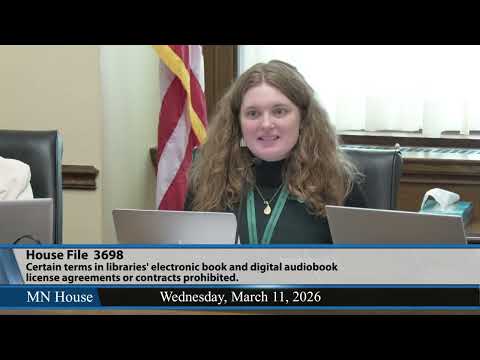
Supporters said the measure would restrict onerous contract terms that govern e-book and digital audiobook licensing for publicly funded libraries and K–12 school libraries. Sarah Hawkins, assistant director at Anoka County Library and legislative chair of the Minnesota Library Association, told the committee libraries often pay far more for digital titles than for print, and that ‘‘these high prices come with restrictive contract terms’’ including short license durations and nondisclosure clauses that limit libraries’ ability to advocate for better terms.
The bill’s sponsor said HF 36,98 would use contract law to prevent provisions that impose artificial caps on lending, prohibit interlibrary sharing, or prevent libraries from discussing pricing. Vivian Peterson, a Hastings High sophomore who testified in support, said limited licenses and long wait times mean students sometimes cannot access required class materials: ‘‘Libraries exist to support education and equal access to information. Let’s keep them that way.’’
Opponents, including Todd Hill of Hill Capital Strategies representing the Association of American Publishers, argued the proposal risks author and publisher rights. Hill said the legislation ‘‘would significantly harm Minnesota readers, undermine the rights of authors and publishers and threaten the availability’’ of titles if publishers choose not to license works under the bill’s constraints. He urged caution, saying changes could reduce licensing of new releases and raise costs elsewhere.
Committee members pressed both sides on concrete effects. Hawkins offered data from Minnesota library reporting showing growing demand for digital formats and said many digital licenses expire after two years or after a set number of checkouts, forcing repurchases. Publishers countered that per-use costs fall as titles circulate and that contract flexibility helps balance library access with creator compensation.
The sponsor emphasized the bill targets contract terms rather than setting prices or regulating content. After discussion the committee approved the motion to refer HF 36,98 to the Elections, Finance and Government Operations Committee for further consideration.
The referral moves the debate to a committee that will have additional opportunity to examine legal challenges raised by opponents and any technical edits proponents propose.