Get Full Government Meeting Transcripts, Videos, & Alerts Forever!
Get email alerts on the Health Insurance topic
No spam. Unsubscribe anytime.
Committee hears detailed briefing on Minnesota’s small but fragile individual health‑insurance market
Summary
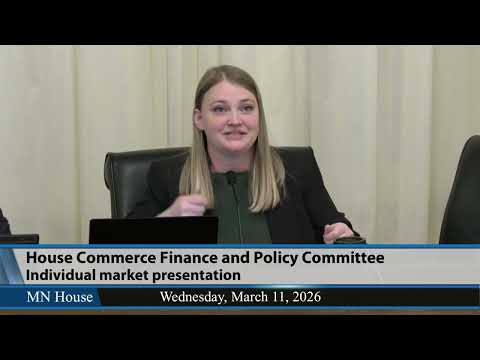
The Minnesota House Commerce and Finance Policy Committee received a 45‑minute briefing from the Minnesota Council of Health Plans on March 11 about the individual insurance market’s instability, the stabilizing role of reinsurance, and drivers of 2026 premium increases; members pressed regulators on recent carrier failures and policy options.
Chelsea Alston, director of the Minnesota Council of Health Plans, told the House Commerce and Finance Policy Committee that Minnesota’s individual insurance market is a small slice of the overall market — roughly 3% of state enrollment — but that it has experienced dramatic enrollment and pricing swings since 2014.
"In 2014 it was about 300,000 Minnesotans; by 2016–17 enrollment dropped sharply when a federal reinsurance program phased out and premiums spiked," Alston said, explaining that the state reinsurance program and temporary subsidies later stabilized carrier participation. She said proposed 2026 rate changes across plans range from about 7.4% to about 30.8%, driven by state mandates, rising health‑care costs and utilization, and the expiration of enhanced federal premium tax credits.
Dan Andresen, a council representative, walked members through how insurers set rates (actuarial projections, geographic rating areas, and required medical‑loss‑ratio standards). He said reinsurance played a central role in restoring choice: "Because of reinsurance, today every county has at least two carriers; without it some counties had only one or none."
Members pressed presenters on the recent instability at a large state carrier referenced in testimony as YouCare. Representative Elkins and others cited figures that YouCare recorded several hundred million dollars in losses in recent years; Elkins said roughly $600 million in cumulative losses were reported around 2024, with much of the exposure coming from Medicare and Medicaid lines rather than the individual market. Sam Smith, testifying for state agencies, said the Department of Health and other regulators worked to resolve the carrier’s insolvency and arrange for other carriers to acquire portions of the business. He said the department is "contemplating strategies to enhance our oversight" and expects proposals in the governor’s budget.
Debate among members highlighted sharply different diagnoses and remedies. Some legislators described reinsurance as a pragmatic, insurance‑industry tool that lowers premiums and improves market participation. Others said reinsurance is an expensive subsidy propping up a structurally failing market and urged broader policy solutions, including sustained premium tax credits or larger systemic reform. Representative Kresha criticized regulators’ monitoring and asked whether earlier oversight could have prevented the rapid swing from surplus to large liabilities; agency testimony said oversight and interagency coordination are ongoing and that future budget proposals will address improvements.
Presenters also reviewed technical drivers: geographic variation in provider costs (counties with single‑hospital systems face higher negotiated rates), reserve requirements, medical‑loss‑ratio mechanics (plans must spend at least 85% of premiums on care), and why uncompensated care and federal payment shifts stress insurers in Medicaid and Medicare lines. Committee members asked for additional data and timelines for 2025 financial results; presenters said 2025 figures should be available in April.
The committee did not take formal legislative action on this presentation itself; chairs thanked presenters and moved to the next agenda items. The briefing anchored several ongoing policy debates the committee flagged for follow‑up: the future of the reinsurance program, the state’s role in market oversight, and how to weigh short‑term subsidies against longer‑term reforms.