Get Full Government Meeting Transcripts, Videos, & Alerts Forever!
Get email alerts on the Dredging Incident topic
No spam. Unsubscribe anytime.
Cameron Parish officials detail Loop Pass dredging spill and ongoing cleanup as fishermen, oyster farmers raise alarms
Summary
Port staff told the parish police jury that an August 2025 dewatering discharge from Loop Pass maintenance dredging carried sediment onto lands adjoining the Cameron Prairie National Wildlife Refuge; remediation is underway, roughly 31,500 of an estimated 49,700 cubic yards removed as of March 7 and dredging is paused pending post‑remediation surveys. Fishermen and oyster growers pressed for more testing, routine reports and a public contact for incidents.
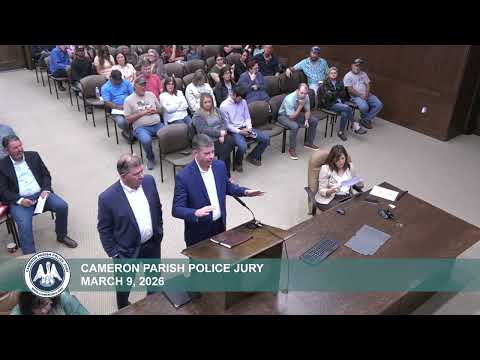
Port staff gave the Cameron Parish Police Jury a technical update March 9 on maintenance dredging at Loop Pass after an August 2025 sediment‑migration incident that deposited material outside the authorized placement area.
Miss Kim Monte, speaking for the port, said dredging under permit 202391 was suspended after unusually high sediment loads were observed during dewatering and placed beyond the Cameron Prairie National Wildlife Refuge boundary. Preliminary estimates identified three accumulation areas: roughly 6.59 acres of off‑refuge accumulation (about 15,948 cubic yards), 13.94 acres on refuge (about 33,735 cubic yards) and a 9.22‑acre shallower vegetated zone (about 2,473 cubic yards). The combined pre‑remediation estimate to restore pre‑incident bathymetry was about 49,683 cubic yards; Monte said crews had removed an estimated 31,527 cubic yards through March 7, 2026, and that dredging was paused March 8 pending a post‑remediation bathymetric survey.
Monte described mitigation measures: an 8‑inch hydraulic dredge for retrieval, turbidity curtains, booster pumps and additional containment benches and berms to lengthen dewatering paths, and a closed slurry conveyance to return spoil to the designated CP2 disposal area. She said the Army Corps of Engineers granted an emergency use authorization on Aug. 13 and the Office of Coastal Management issued a related authorization Aug. 15. Monte also said Venture Global, the project partner that funded and executed the original permitted work, has increased monitoring and preventative measures since the incident and is coordinating regular update calls with state and federal agencies and the port.
Fishermen, oyster growers and residents raised urgent questions. Cooper Fornette told the jury he had been monitoring task‑force email records and asserted there were additional incidents not covered in the port presentation, including a Jan. 16, 2026 opening in a BMP that released spoil and a Feb. 18 slurry‑line hole that allowed material to escape before the weir was closed. "You deserve to know the whole truth," Fornette said.
Oyster farmer Anthony Terry said mud from pipelines has reached roads and product and asked the parish to keep dredging and spill information on every agenda and to provide a reporting contact for near‑real‑time problems. "We shouldn't have to go by and check to see if mud's leaking," he said.
Brandon Dearts, a resident and fisherman who spoke at length, tied the dredging complaints to broader community impacts: traffic congestion from industrial shift changes, damage to small boats from heavy tug traffic in the channel, and loss of access and dock space for local fishermen. He urged the parish and Venture Global to negotiate buyouts where appropriate and called for better protections for residents and working waterfront users.
Port staff said the no‑name weir remains closed and that further dewatering will use dewatering boxes and systems designed to reduce migration; they said monitoring and weekly coordination calls with agencies have continued since August. A post‑remediation survey will determine whether bathymetry has returned to pre‑accumulation depths before any resumed placement.
Jurors and the public pressed for more transparency: requests included routine agenda updates on remediation progress, confirmation whether state agencies such as the Office of Coastal Management or LDWF would perform independent studies, clearer lines for reporting observed releases, and a plan for ongoing fisheries testing. A KPLC reporter asked whether the Louisiana Department of Wildlife and Fisheries had performed an independent Big Lake study; staff said no independent study had been commissioned by LDWF to the jury.
The port's technical presentation and residents' statements underscore a continuing tension: port and contractor actions to remediate spoil and meet permit conditions, and community demands for frequent, tangible evidence that fisheries, navigation and marsh habitats have been restored. The parish said it would continue coordination with state and federal regulators and requested that future meetings include regular updates on dredging remediation and monitoring.