Get Full Government Meeting Transcripts, Videos, & Alerts Forever!
Get email alerts on the School Safety topic
No spam. Unsubscribe anytime.
El Rancho Unified details safety upgrades, training and interagency coordination on district podcast
Summary
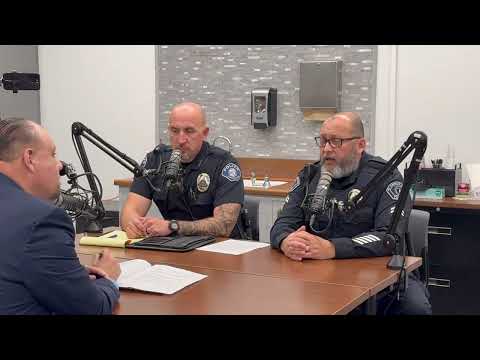
Superintendent Dr. Marco Vias hosted Chief Luis Gomez and Officer Carlos Flores to outline El Rancho Unified School District's police staffing, visitor-screening technology, camera upgrades, radio interoperability with the sheriff and student reporting tools, and to describe emergency protocols and training.
Dr. Marco Vias, superintendent of El Rancho Unified School District, hosted a podcast episode focused on campus safety with Chief Luis Gomez and senior officer Carlos Flores, who described the district's police staffing, technology investments and emergency procedures.
Chief Luis Gomez said the school police department was established in 1984 and now includes "four sworn police officers," a dispatcher/office manager, about "15 part-time SSOs" and six full-time senior SSOs. "They're basically our boots on the ground when it comes to school safety," Gomez said, describing the staff as the district's primary on-site safety presence.
Gomez described mandatory and ongoing training for officers. "Each one of us attended an 868 hour ... police academy," he said, and added that officers complete a mandated 40-hour campus safety training block before being sworn. He emphasized continuing education to keep up with legal changes and evolving best practices.
On technology, Gomez said the district uses Raptor visitor-screening software at main entrances: clerks scan IDs and the system flags "hits" for potential criminal-background matches that prompt school police or sheriff notification. "If any...hits or any responses come back with anything having to do with any kind of criminal background hit...school police and the sheriff's department are immediately notified," he said.
The district has also upgraded its campus cameras, which Gomez called a "top-of-the-line" system (referred to in the episode as the Verata system), and has replaced older patrol cars with Ford Explorer police vehicles that can double as mobile command posts. "They're better with the fuel efficiency...cutting down on our response times with reliable vehicles," he said.
Gomez said the school police radio system is now interoperable with Los Angeles County Sheriff's dispatch in Pico Rivera, allowing responding deputies to coordinate more effectively with school staff and the district's officers during incidents. He also highlighted an anonymous reporting mechanism discussed in the episode as "Texa tip" and the Catapult system, which allow students and staff to report concerns while remaining anonymous.
Describing how the district handles significant incidents, Gomez outlined the role of the Emergency Operations Center (EOC) and site-level incident commanders. "We have the Incident Commander...they will assign a logistics person who's the one that's going to be the contact 911," he said, describing how schools decide whether an event remains isolated to a single campus or requires districtwide EOC activation.
Officer Carlos Flores and Gomez described on-site roles during lockdowns: principals serve as incident commanders, designated staff members carry out assigned tasks such as locking gates and accounting for students, and the school police form tactical responses while first responders are en route. Gomez said incident commanders keep detailed logs in line with the National Emergency Management System so the district can document events and pursue federal reimbursement where applicable.
Gomez said the district meets monthly with the sheriff's office and other key partners, conducts multi-agency active-shooter drills with the sheriff, California Highway Patrol and fire department, and shares aerial campus maps and walkthroughs with partner agencies to keep plans current.
On prevention and community involvement, the guests highlighted student assemblies, the "see something, say something" campaign, the Promise program and Red Ribbon Week as ongoing efforts to educate students and involve parents in safety work. "The parents showing up for us week in and week out...are one of our biggest stakeholders," Gomez said.
Dr. Vias closed by thanking the school police and reiterating the district's commitment to continuous training, improved communication with the public and ongoing partnerships with local law enforcement and fire agencies. The podcast ends with a note that future episodes will address additional district topics.