Get Full Government Meeting Transcripts, Videos, & Alerts Forever!
Get email alerts on the Autonomous Vehicles topic
No spam. Unsubscribe anytime.
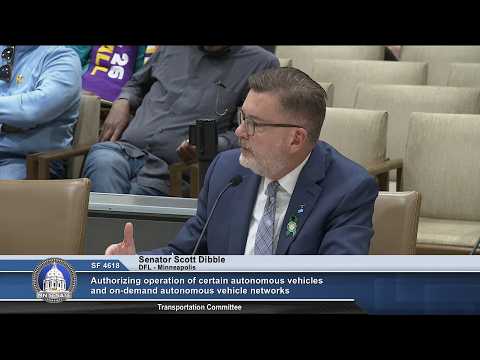
Senate committee moves omnibus autonomous‑vehicle package after heated, hours‑long debate
Summary
The Senate Transportation Committee voted to recommend Senate File 46‑18, an omnibus bill creating a phased permitting system, an advisory study, independent safety verification, incident reporting and accessibility requirements for commercial automated/autonomous vehicle operations; several amendments strengthened disability access and set a study on whether a human operator should be required.
After several hours of testimony, amendments and debate, the Senate Transportation Committee on Wednesday recommended passage of a broadly drafted omnibus bill intended to govern commercial automated/autonomous vehicle operations in Minnesota.
Sponsor testimony described the bill as a two‑phase approach: an initial study and advisory process to evaluate workforce, safety and equity impacts, and a permitting framework that would allow regulated commercial deployment once conditions are met. Key elements included independent third‑party safety verification, annual permit applications with detailed disclosures and incident reporting (crashes, near‑misses, disengagements), first‑responder interaction plans, enforcement authority (including suspension and revocation), public transparency requirements and local‑government engagement on traffic analyses.
“The bill requires a comprehensive study covering workforce, economic, safety, infrastructure and accessibility impacts,” the sponsor said. Supporters and opponents both urged careful design: city representatives warned about a patchwork of local rules and discussed existing municipal fee structures; disability advocates pushed for stronger accessibility measures and alternatives for riders without smartphones. The committee adopted many amendments, including instructions for the advisory task force to study whether a human operator should be required during commercial operations (A20, adopted 7–4), and accessibility provisions requiring DMV consultation with the Governor's Council on Disability, an emergency‑service direct‑connect capability, and targets or incentives to ensure wheelchair‑accessible vehicles are available in networks (A15, A17, A18, A25 among others).
Committee staff also reviewed a fiscal note that outlined agency costs: Commerce estimated additional staffing and enforcement costs (roughly $499,000/year initial for positions), Department of Public Safety and State Patrol proposed several FTEs and a contract for public outreach (tens to hundreds of thousands annually), and Driver and Vehicle Services expected rulemaking and programming costs (one‑time and absorbed in existing contracts). The bill as amended was recommended to pass and referred to the Senate Judiciary Committee for further consideration.