Get Full Government Meeting Transcripts, Videos, & Alerts Forever!
Get email alerts on the School Bond topic
No spam. Unsubscribe anytime.
Board holds first reading of school bond; trustees signal lower tax‑rate target and ask for revised scenarios
Summary
At a June 4 first reading, bond counsel reviewed a draft Proposition 39 resolution for a facilities bond. Trustees asked staff for conservative and aspirational financing scenarios and signaled community support for a lower tax‑rate estimate (~$29 per $100,000 assessed value) and a shorter or flexible term to improve voter prospects.
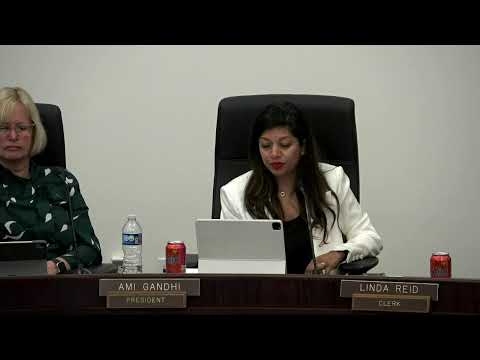
The Palos Verdes Peninsula Unified School District board received a first reading and staff briefing on a proposed Proposition 39 school bond on June 4, asking counsel and financial advisors to return with refined scenarios before finalizing language for the ballot.
Don Field, the district’s bond counsel, reviewed the draft resolution and exhibits, including a ballot measure text and a tax information statement that discloses estimated tax impacts and total debt service. He noted Prop. 39 accountability requirements and a need to clarify wording about projects that are contingent on state matching funds.
Trustees pressed staff on two central points: whether some projects required state matching dollars, and how to present a prioritized project list that is transparent yet flexible enough for Department of State Architect (DSA) requirements and unforeseen construction issues. “We will clarify state‑matching language and include caveats to avoid promising projects that can’t proceed without additional appropriations,” Field said.
Board members discussed limits on so‑called “soft costs” such as design and DSA fees and on the useful life calculation that federal tax rules apply to bond‑funded assets. Legal and financial advisers explained those constraints and recommended draft language that aims to reassure voters while preserving necessary flexibility during construction.
The board debated the tax‑rate and term assumptions used to estimate proceeds. After widespread community outreach, trustees signaled a preference for a lower tax‑rate scenario to improve the bond’s political prospects. Several trustees expressed support for a $29 per $100,000 assessed‑value estimate and for a 20‑year maximum term as an assumption to present to voters; counsel and the financial advisor agreed to model both conservative and more optimistic scenarios for the June 26 meeting.
Trustees and staff also discussed a recommended set of accountability criteria (competitive bidding, a prioritized project list, annual reporting and estimates of borrowing costs) to include in the final resolution. Bond counsel said staff would return with revised language, two or more revenue scenarios and draft prioritization language that permits limited board flexibility when state or site constraints require adjustments.
No bonding authorization was adopted at the meeting; the board set direction for staff to prepare a revised resolution for consideration at its June 26 meeting.