Get Full Government Meeting Transcripts, Videos, & Alerts Forever!
Get email alerts on the Utility Regulation topic
No spam. Unsubscribe anytime.
Committee debates bill to cap executive pay recoverable from utility rates; motion to re‑refer fails
Summary
Members heard House File 76, which would limit the amount of executive compensation investor‑owned utilities can recover from ratepayers (indexed to the governor’s salary); public commenters and consumer groups supported the cap, utilities urged existing Public Utilities Commission oversight, and a motion to re‑refer the bill failed on a roll call, leaving the measure laid over.
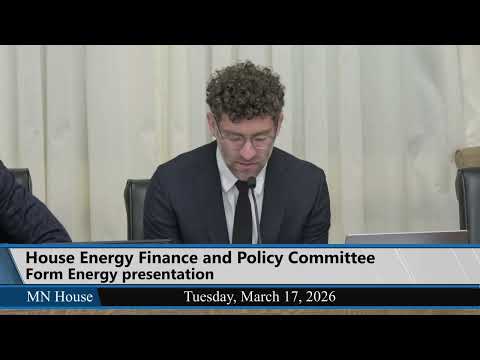
The Energy Finance and Policy Committee debated House File 76, a proposal to cap the amount of executive compensation that investor‑owned utilities can recover from ratepayers. Representative Green introduced the bill, which would limit recoverable executive pay to the salary of the governor (as a proxy for reasonable public compensation), and the committee considered and adopted a technical 'A1' amendment before hearing testimony.
Several residents recounted hardship from rising utility bills and urged passage. Andrea Storm, who identified herself as a Minneapolis resident, said an Excel rate increase would exacerbate personal financial strain: "No money from a ratepayer like me should go to line the pockets of already wealthy business owners," she said. Multiple witnesses from advocacy organizations — including Carly Weinman of the Energy Policy Institute — backed the bill as a targeted, non‑binding statute that would protect captive ratepayers while preserving utilities’ ability to pay executives from shareholder funds.
Utility witnesses countered that the Public Utilities Commission (PUC) already scrutinizes executive compensation in rate cases, that at‑risk compensation typically is excluded from rates, and that some executive costs are shared across multiple jurisdictions. Jim Pearson of Xcel Energy said the regulatory process is the appropriate venue to test reasonableness, and Jason Losom of CenterPoint noted the commission’s quasi‑judicial hearings require evidence and a burden of proof.
Committee members debated scope and enforcement: supporters argued a statutory cap creates a clear, uniform protection for captive ratepayers; opponents warned that statutory limits risk duplicating or conflicting with PUC oversight and questioned whether the change could unintentionally shift costs. Representative Green moved to re‑refer HF76 to the General Register with the amendment; the roll call did not reach the votes needed and the motion failed, so the bill was laid over for further consideration.
The committee did not enact a statutory cap at the hearing; further committee work and possible floor action were left open.