Get Full Government Meeting Transcripts, Videos, & Alerts Forever!
Get email alerts on the Vaccination Policy topic
No spam. Unsubscribe anytime.
Committee moves MMR exemption bill to Education Policy after heated debate over public health and parental rights
Summary
SF 3439, which would remove the conscientious-objection exemption for the MMR vaccine, drew extensive pro- and anti- testimony and was referred to the Education Policy Committee for further review.
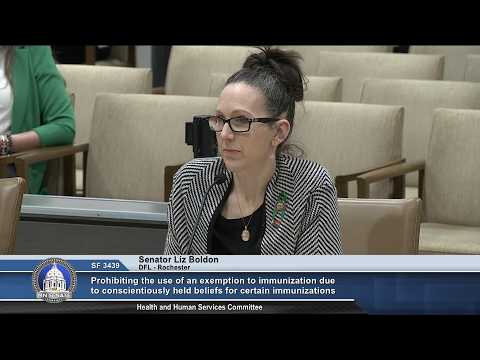
Senate File 3439, a proposal to eliminate the "conscientiously held belief" exemption for measles-mumps-rubella vaccination for school entry, was discussed at length and referred to the Education Policy Committee on March 17.
Sen. Jennifer Boldon, the bill’s author, framed the measure as a response to falling kindergarten vaccination rates and rising measles cases. "Even modest declines in vaccination coverage can significantly increase the risk of outbreaks," she said, citing Minnesota Department of Health reporting and national trends.
Dr. Kaitlin McLean, a pediatrician representing the Minnesota Chapter of the American Academy of Pediatrics, told the committee that roughly 86% of Minnesota kindergartners were fully vaccinated against measles and that public-health authorities aim for about 95% to maintain community immunity. She said measles is highly contagious, can cause severe complications and that current case counts include recent cases in 2026.
Opponents — including parents and advocacy groups — argued the bill infringes on parental rights and free-exercise protections and described alleged vaccine injuries and difficulty obtaining medical exemptions. Testimony included personal accounts from Jessica Yudchitz and others asserting adverse reactions or administrative hurdles to receiving medical exemptions.
Committee members pressed witnesses for data and clarification. Dr. Lisa Mattson and Dr. McLean answered questions about the numbers of cases and vaccination effectiveness; members debated how many recent cases involved fully vaccinated children. After discussion, the chair and members voted to move the bill to the Education Policy Committee for additional consideration.
The referral does not represent a final decision on the policy; Education Policy will consider the bill’s educational and operational implications, medical-exemption processes and constitutional concerns.