Get Full Government Meeting Transcripts, Videos, & Alerts Forever!
Get email alerts on the Public Health topic
No spam. Unsubscribe anytime.
Minnesota lawmakers, advocates push to ban paraquat and create Parkinson’s research trust fund
Summary
Lawmakers and patient advocates urged passage of two bills: one to ban the herbicide paraquat in Minnesota and another to create a state Parkinson’s Disease Research Trust Fund to coordinate and fund research; sponsors announced an upcoming AG Committee hearing and the paraquat bill was held over pending a fiscal note.
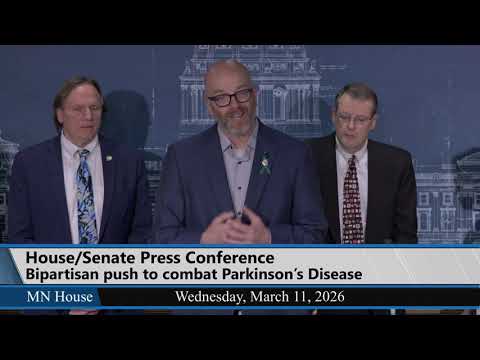
A group of lawmakers, patients and national advocates gathered to press Minnesota legislators to ban the herbicide paraquat and to establish a Minnesota Parkinson’s Disease Research Trust Fund to support coordinated research and caregiver services.
State Representative Christie Purcell, the House author of the research fund bill, said the measure would create a dedicated pot of state money to coordinate research among Minnesota institutions and support local science. "We have these incredible research institutions, the University of Minnesota, Mayo Clinic, et cetera," Purcell said, framing a state trust fund as a way to strengthen local capacity.
The event centered on two linked messages: prevention through limiting exposures and investment in research. Dan Feehan, chief policy and government affairs officer for the Michael J. Fox Foundation for Parkinson's Research, summarized recent studies tying paraquat exposure to higher Parkinson’s risk: "Research shows that people who handle paraquat are about twice as likely to develop Parkinson's disease in their lives," Feehan said, and he cited studies that also show elevated risk for residents living within roughly 500 meters of treated fields.
Multiple people living with Parkinson's described daily symptoms and long-term impacts. Patrick Ryan, diagnosed 11 years ago, described community programs such as Rock Steady Boxing that help patients remain active. Lynn Johnson, who said she has had Parkinson's for 15 years, recounted the emotional toll of diagnosis and caregiving: "One day he got mad at me and he was yelling and he said, 'Mom, it doesn't matter what to say because you're going to be dead soon,'" she said, describing her son's reaction as a child.
Sponsors and advocates also pointed to international precedent and industry changes. Organizers noted that many countries, including the European Union, have banned paraquat and that some manufacturers have stopped production; supporters argued that a state ban would reduce preventable exposures. Organizers acknowledged anticipated opposition from agricultural interests and industry lobbyists.
On process and next steps, organizers announced a hearing in the Agriculture Committee at 1:00 p.m. A representative noted the paraquat bill would be "held over" for now because lawmakers requested a fiscal note to assess state costs; sponsors encouraged constituents to contact their legislators.
The event combined personal testimony, scientific summaries and legislative strategy. Supporters urged lawmakers to treat the package as both a public-health prevention measure and an investment in Minnesota-based research and care. The organizers closed by thanking the patient speakers and advocates for sharing their stories; the sponsors said work will continue as the bills move through committee.