Get Full Government Meeting Transcripts, Videos, & Alerts Forever!
Get email alerts on the Risk Management Overview topic
No spam. Unsubscribe anytime.
Santa Fe County risk staff outline investigations, tort-claim process and safety priorities on county podcast
Summary
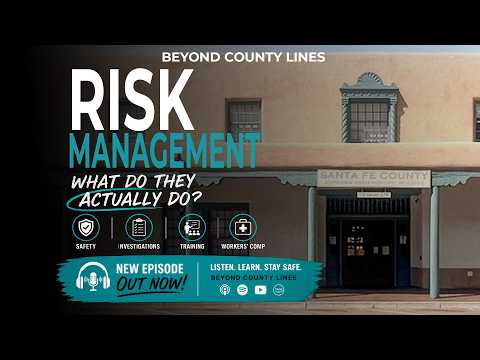
On the county podcast "Beyond County Lines," Santa Fe County risk-management staff described their shift from a policing role to education, explained how investigations and tort claims are handled (often routed through the clerk's office and insurers), and highlighted core safety trainings for employees.
Santa Fe County risk-management staff used the county podcast "Beyond County Lines" to explain how the division handles workplace incidents and tort claims, to describe a shift toward a more customer-service approach, and to encourage employees to take core safety trainings.
Risk staff said the division's role is primarily fact gathering after incidents. "All we do is gather the facts," a risk employee said during the episode, stressing that disciplinary decisions are made by HR or department directors. The speakers outlined a typical pathway: incident notification to risk, field fact-finding (photos, measurements), referral to the clerk's office, legal review, and then insurer determination at the county's level.
Roads and emergency-response incidents were repeatedly cited as common sources of tort claims. Staff noted that many surface-related complaints (potholes, fresh chip seal or striping issues) require jurisdictional verification because projects may be run by the state or city rather than the county; jurisdiction determines where a claimant should file and whether the county can pay the claim.
The episode highlighted a culture change inside risk: instead of being seen as "the office police," staff said they are emphasizing education and practical help. "We're trying to take more of a customer service approach," a risk team member said, urging employees to contact the office with questions and to take advantage of available trainings.
Speakers encouraged employees to complete job-appropriate trainings and described a training matrix the division is developing that ties required classes to job descriptions. They mentioned recurring schedules for core classes (for example, certain driving-related certifications and first-aid trainings are refreshed at multi-year intervals) and noted many classes are already posted on the county employee calendar in SharePoint.
The episode closed with staff recognition: supervisor Epy (also spelled "Eppy" in the episode) Tapia was introduced as present on the recording; other team members acknowledged included Eric Martinez (safety coordinator) and Melinda Jay Guzmankino (introduced with a HR/risk leadership title in the episode). Hosts encouraged listeners to sign up for classes and to follow the podcast on streaming platforms.
Next steps described on the show include continued updating of emergency-action plans, lockout/tagout and hazardous-communications materials, and making more trainings available internally.