Get Full Government Meeting Transcripts, Videos, & Alerts Forever!
Get email alerts on the State Budget Change Package topic
No spam. Unsubscribe anytime.
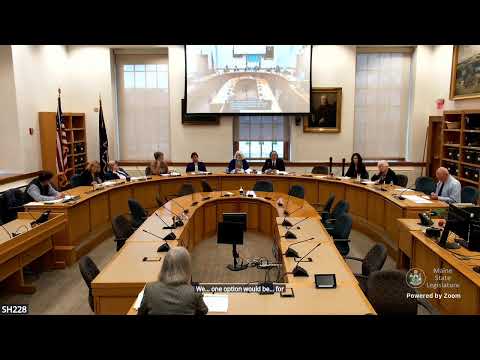
Commissioner presents governor's LD2212 change package; lawmakers press over rainy-day withdrawals and highway-fund shortfall
Summary
Commissioner Elaine Clark outlined the governor's FY26–27 supplemental change package LD2212, including a $324.7M proposed draw from the Budget Stabilization Fund for affordability, housing and public defense and a ~$13M transfer to the highway fund; lawmakers pressed for statutory, timing and cost details on CDS fees and teacher-salary proposals.
Commissioner Elaine Clark of the Department of Administrative and Financial Services presented the governor's change package to the Joint Standing Committee on Appropriations and Financial Affairs, explaining the supplemental adjustments to LD2212 following the Revenue Forecasting Committee's March 1, 2026 report.
Clark told the committee the change package updates the governor's original supplemental for the 2026–27 biennium to reflect revenue adjustments and specific program corrections. She said the package includes roughly $7.7 million in net deappropriations and a one-time transfer of about $13 million from the general fund to the highway fund to offset projected declines in alcoholic-beverage transfers and other highway-fund revenues, producing an overall general-fund biennial total of approximately $11.926 billion.
The commissioner described numerous technical amendments and program-level changes. Highlights included continued funding for several positions (DOE, judicial staff for implementation of an extreme-risk protection order act), reclassification adjustments summarized in appendix A (general-fund total $542,274), rebasing the hospital tax to FY2024, and changes to the elective pass-through entity and business-equipment reimbursement provisions to reflect committee recommendations and public comment.
Clark also described a set of changes affecting Child Development Services (CDS): language allowing the Department of Education to move unencumbered balances from general-purpose aid into CDS on a one-time basis and an authorization (Part WW) for CDS to assess fees and invoice School Administrative Units for supports and staff. Clark said the fee arrangement implements a prior statutory reconfiguration (PL 2023, ch. 643) and she pledged to provide detailed written answers from DOE finance staff about whether the fees are new and how they will be assessed.
A central point of the hearing was the governor's proposed use of the Budget Stabilization Fund (BSF). Clark said the administration seeks $324.7 million from the BSF composed of $218.5 million for direct $300 payments (described as $600 per family in some references), $70 million for housing initiatives, $25.44 million for public-defense services, $5.9 million for school-bus retrofits to improve safety and $5 million to help DHHS upgrade technology to comply with a statutory requirement. Clark said the remaining BSF balance would still be “substantial,” on the order of roughly $700 million.
Lawmakers pressed how tapping the BSF would affect the state's fiscal profile. Several members asked whether withdrawing one-third of the fund would risk a bond-rating downgrade. The state controller, Doug Cotton, who joined the hearing, said there is no direct, quantifiable point-for-point correlation between a single reserve figure and a rating, but that rating agencies do consider the state's fiscal position, management and stress-test results; reducing the BSF below its statutory cap of 18% would be reviewed but the proposed level would remain above some historical minimums referenced by raters.
Several legislators objected to using BSF money for the proposed affordability checks and housing initiatives absent an explicit revenue shortfall or downturn affecting state operations. Some said withdrawals should be limited to circumstances contemplated by statute; others noted the BSF has been tapped multiple times since 2010 and that any change could be enabled by 'notwithstanding' language adopted by the Legislature.
Members also sought details about the timing and mechanics of the $300 payments. Clark said payments could begin after the budget becomes effective — likely mid-July under normal implementation — unless an emergency clause were adopted to accelerate distribution. Committee members noted the administration is relying on the March 1 RFC forecast and that the state may seek updated forecasts if unusual economic developments occur.
Tax conformity questions drew technical answers from Dr. Michael Allen, who said federal OB3 provisions temporarily provide a personal exemption for some seniors but that Maine already provides an equivalent personal exemption; the governor is not proposing additional conformity for the senior deduction in the change package.
Committee members requested further written follow-ups including (1) the specific fee amount(s) and billing mechanics for CDS invoicing to SAUs, (2) confirmation of any reclass/headcount changes added after the original supplemental, and (3) state and local cost estimates for the proposed teacher-salary minimum increases. Clark agreed to provide these details and to consult with DOE and agency finance staff as needed.
The committee did not take votes during this hearing. Chair Peggy Rotundo closed the session and said members would continue work in a scheduled work session and follow up on the outstanding technical questions.
Ending: The hearing concluded with the committee requesting agency follow-ups on CDS fees, reclass/headcount clarifications and teacher-salary cost estimates; the committee did not act on LD2212 during the session.