Get Full Government Meeting Transcripts, Videos, & Alerts Forever!
Get email alerts on the Qwi Naics Release topic
No spam. Unsubscribe anytime.
Census rolls out NAICS 5‑ and 6‑digit detail in Quarterly Workforce Indicators and updates QWI Explorer
Summary
The U.S. Census Bureau has added state-level NAICS 5- and 6-digit detail to its Quarterly Workforce Indicators (QWI) and updated the QWI Explorer to improve navigation and sharing. Presenter Andrew Foote demonstrated state case studies (PA, CA, OH, WV) and explained access via the Census API and LED extraction tool.
The U.S. Census Bureau on its Local Employment Dynamics webinar introduced newly released NAICS 5‑ and 6‑digit tabulations for the Quarterly Workforce Indicators, giving state analysts new industry detail while keeping the data release at the state geographic level.
In a presentation and live demonstrations, Andrew Foote, local economist for LEHD research in the Census Bureau’s Center for Economic Studies, showed how the finer NAICS breakdowns let users see distinct trends obscured at the four‑digit level. "We finally were able to release NAICS five and six-digit QWI tabulations," Foote said, noting the update lets analysts compare hiring, separations, turnover and earnings by detailed industry and worker characteristics.
Why it matters: The new levels let state analysts and researchers distinguish dynamics inside aggregated sectors — for example, Foote demonstrated that in Pennsylvania new single‑family home construction collapsed after the 2006 peak and has not recovered, while residential remodelers have grown, a difference that the four‑digit sector masks.
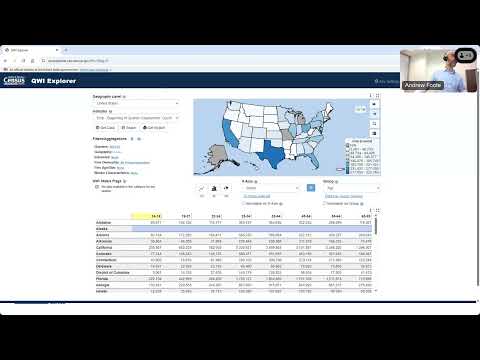
Foote also highlighted usability updates to the QWI Explorer, including navigation memory when drilling from a sector to lower NAICS levels and improved NAICS search logic, plus a map/geography preservation feature when switching states. "The explorer now remembers selections and makes multi‑state comparisons and link sharing much easier," he said.
In live case studies Foote used state examples to show how the NAICS 6 detail changes interpretation: in California, grape vineyards show long declines while tree‑nut farming (notably almonds) has grown and historically employed a majority Hispanic/Latino workforce; in Ohio and California different machinery manufacturing subsectors showed opposite trends; and in West Virginia disaggregation revealed robust growth in natural gas extraction alongside declines in crude petroleum extraction.
Access and limits: Foote said the NAICS 5‑6 QWI tabulations are available at the state level and that there are currently no plans to publish the five‑ and six‑digit detail at county or metro levels because many cells would be suppressed for disclosure protection. "There's no plans right now to make it available at a lower level of geographic detail," he said, explaining the disclosure constraints.
Users can access the data through multiple channels: the Census API (QWI endpoints), the LED extraction tool, and the QWI Explorer interface, which supports CSV/Excel downloads and shareable Explorer URLs for collaboration. Foote noted Q1 and Q2 2025 data were already available for most states but a few states lag because of late submissions or MOUs.
What QWI does not provide: In response to questions, Foote said occupation data (SOC/O*NET) will not be part of regular QWI releases because occupation fields are not present on many states’ unemployment‑insurance wage records; race and ethnicity are completed in production via imputation when missing from administrative inputs.
The webinar concluded with Foote pointing attendees to supporting resources (QWI help/QWI 101, QWI schema, LED extraction tool) and an America Counts story that uses the new detail. The Census Bureau said the presentation materials and recording will be posted to the Census Academy site within 30 business days.
Next steps: The Census announced upcoming LED events and a May LED workshop where users can get further training and share use cases.