Get Full Government Meeting Transcripts, Videos, & Alerts Forever!
Get email alerts on the Patient Centered Care topic
No spam. Unsubscribe anytime.
Senate committee hears split testimony on bill to replace Medicaid managed care with state-directed, "patient-centered" payment model
Summary
Senate File 3612 would shift Medicaid and MinnesotaCare payments from risk-bearing managed-care organizations (MCOs) to direct payments by DHS, using non-risk Administrative Service Organizations for claims processing and expanding provider-led care coordination; proponents cited Connecticut savings and transparency gains, opponents warned of lost care coordination and fiscal risks.
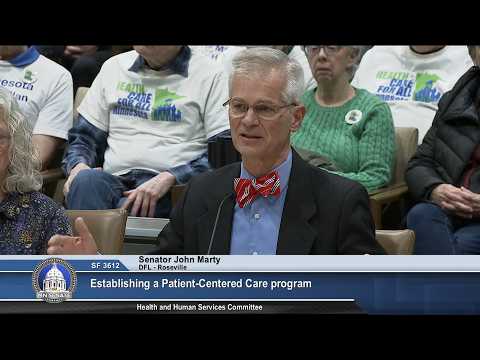
Sen. Marty introduced Senate File 3612 on March 10, 2026, proposing a statewide "patient-centered care" system that would end the state’s reliance on risk-bearing managed-care organizations for Medicaid and MinnesotaCare and have the Department of Human Services pay providers directly.
Supporters, including the sponsor and out‑of‑state witnesses, said the change would reduce administrative overhead, improve transparency and return case‑management and care coordination to medical professionals and counties. Sheldon Toubman, an attorney with Disability Rights Connecticut and New Haven Legal Assistance, told the committee Connecticut transitioned away from risk-bearing MCOs and achieved large savings and higher provider participation under a non‑risk ASO model. He said Connecticut now captures a higher medical‑loss ratio (about 97 percent) and that ASOs performed claims processing without a financial incentive to deny care.
Nancy Westman, a psychiatric nurse practitioner, described cases she said exposed harms tied to prior authorization, limited networks and unreimbursed case‑management work under the MCO model; she told senators she and clinic staff spend substantial unpaid time navigating county and MCO systems to secure services for patients. Dr. Daniel Trajano, a retired primary‑care physician, said he supported reducing administrative burden but cautioned that any new system must avoid creating multiple competing reporting requirements that would re‑impose complexity on providers.
Chelsea Olson, representing the Minnesota Council of Health Plans (the trade association for nonprofit health insurers), opposed the bill. Olson said MCOs currently provide thousands of care coordinators, leverage commercial networks to secure provider access for MA enrollees, and operate contract provisions (including withholds and encounter reporting) that are intended to promote accountability. Olson warned that ending managed care could shift financial risk and program complexity to the state and potentially affect programs and waivers that rely on the managed‑care structure.
Committee members pressed the sponsor and witnesses on implementation details. Sen. Utke asked how large a new DHS administrative function would be and whether DHS could take on claims processing and provider relations; Sen. Lieske and others raised concerns that paying providers directly could reduce negotiating leverage for MA patients and that provider reimbursement rates must be adequate to preserve access. Sen. Port and Sen. Boldon emphasized patient‑facing delays they or constituents have experienced when care required prior authorization. Several senators asked for a fiscal note and transition plan; the sponsor said a fiscal note was pending and pointed to Connecticut’s reported 14 percent savings as evidence of potential long‑term savings.
An author’s amendment (A1) was offered by Sen. Mann and adopted. The committee did not take a final vote to pass the bill out of the committee to the floor on March 10; legislators repeatedly requested a fiscal analysis and additional implementation detail before taking further action. The hearing record shows substantial agreement that administrative burdens exist, but witnesses and members disagreed about whether eliminating risk‑bearing MCOs is the best or only remedy.
Next steps: sponsor and staff are awaiting the fiscal note and additional implementation details; the committee did not report the bill out of the committee on March 10.